Guitar Chords Chart
This is a guitar chords chart for standard tuning (E A D G B E), from the lowest/thickest string to the highest/thinnest string. I built it from years of teaching beginners their first shapes: find a chord, see exactly where your fingers go, start with the handful that matter most, then use the printable poster when you want the full reference.
Start here: the first guitar chords to learn
If you're new to guitar, start with Em, Am, E, A, D, G, and C. These open chords are easier to play than barre chords, they use standard tuning, and they turn up in thousands of songs.
Don't try to memorize every chord at once. Learn two or three shapes, practice changing between them slowly, then add the next chord once the changes feel steady.
Free guitar chords chart for standard tuning
The essential open chords below are the first shapes most guitar players should learn in standard tuning. These use the same diagram style as the full Kalymi Music poster, so what you practice here matches the printable reference exactly.
Essential open chords (standard tuning)

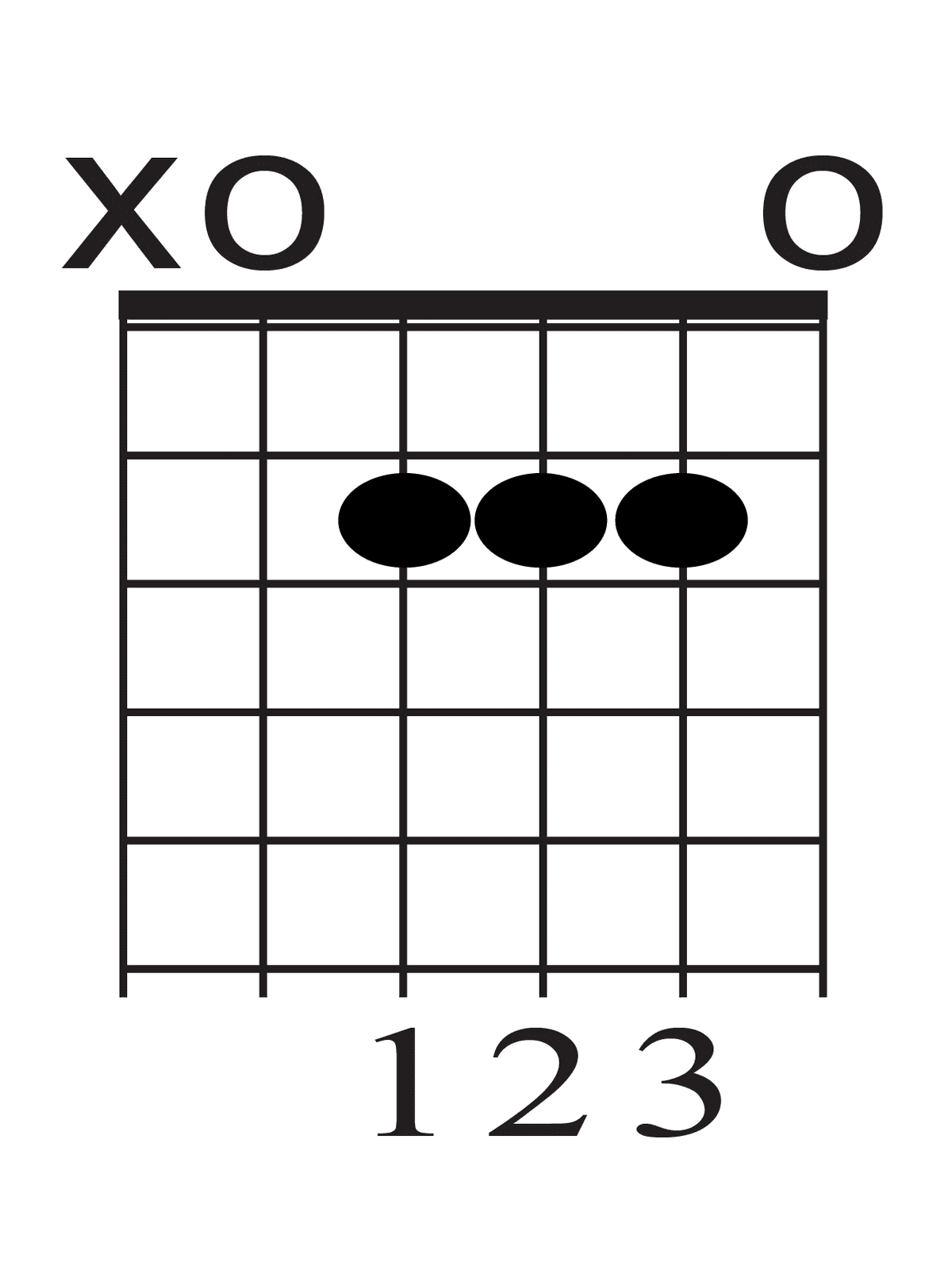
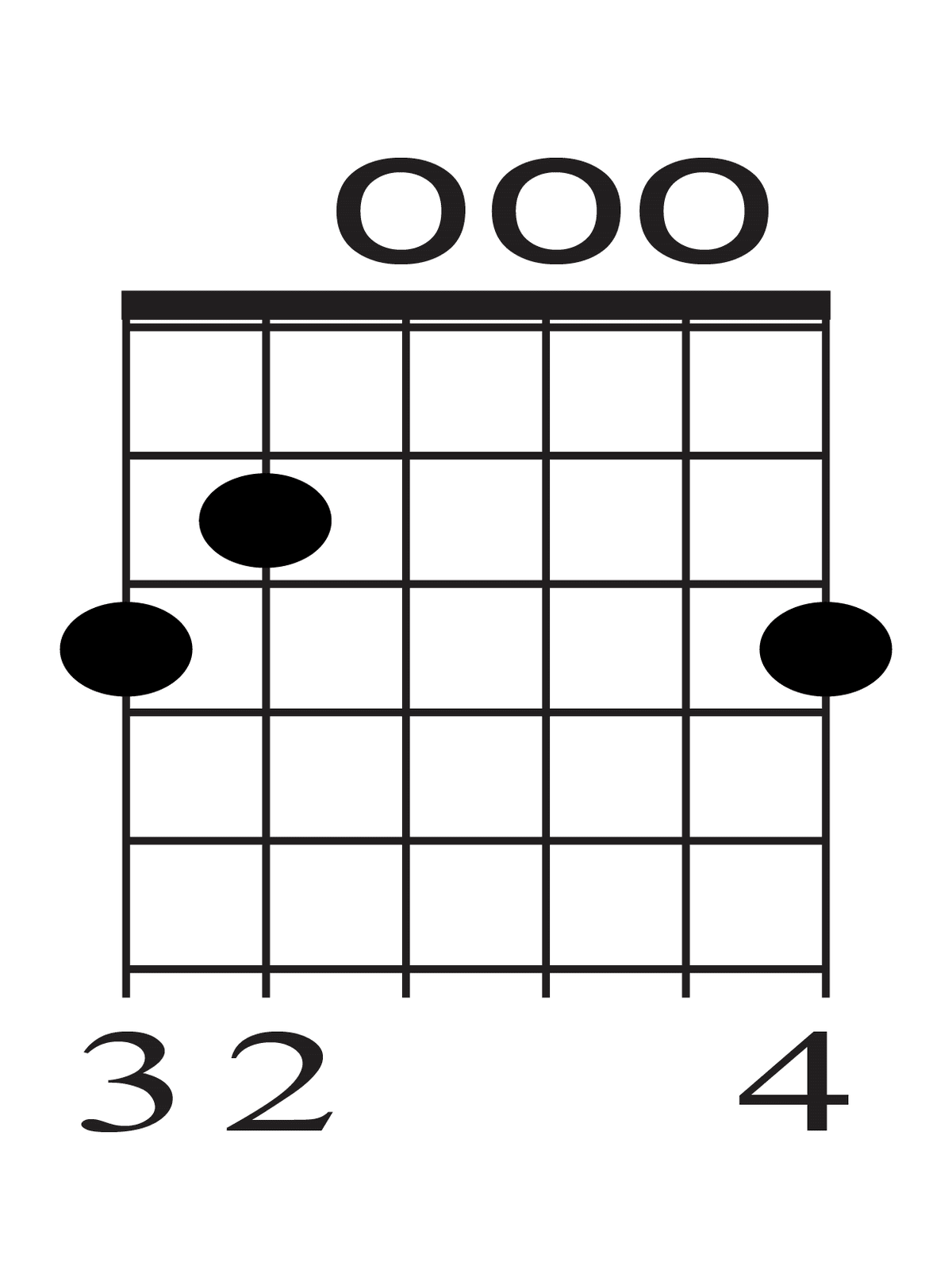


These essential open chords are free. Barre and power chord examples are shown further down, and the full set is on the printable Guitar Chord Poster + eBook: 96 chords on the poster and 168 in the eBook.
Free printable PDF: download the 20 essential guitar chords from this page on one clean printable sheet: open chords, 7th chords, barre chords, and power chords in standard tuning.
Download the Free Guitar Chords PDF ↓How to read a guitar chord chart
Every chord diagram is a snapshot of the neck as if you stood the guitar up and looked straight at it. Once you can read one, you can read them all. The chart below breaks it into the three things you need.

Fingering
The finger numbers are the same on every chart: 1 index, 2 middle, 3 ring, 4 pinky, and T for thumb. The hand is drawn palm up, the way you look down at your own fretting hand.
Open chords (the Am example)
- The vertical lines are the strings, with the lowest, thickest E on the left, and the horizontal lines are the frets. The thick bar across the top is the nut.
- A dot shows where to press a string down, and the number beneath the diagram tells you which finger to use.
- An O above a string means play it open. An X means don't play that string at all.
Barre chords (the F#m example)
The thick black bar across several strings is a barre: one finger, almost always the index, pressed flat to hold down several strings at once. Notice the row of 1s beneath the F#m diagram: that shows the index finger barring across the strings, with the other fingers stacked above it.
Why these diagrams look a little different
A diagram will only take you so far. After years of lessons I can tell you that almost every student learns a chord faster by watching it played and seeing exactly where my fingers land, then using the diagram afterward to jog the memory. The picture is the reminder, not the lesson. That's why every chord in my Beginner Guitar Chord Book comes with a short video of me playing it.
I also learned, by surveying my students directly, that people read chord diagrams in different ways. So I teach from what's worked in the room rather than passing along the same charts everyone copies from everyone else. My diagrams use a dot system and a reversed fingerboard that most students take to quickly, even though it differs a little from the popular methods. It might click for you, it might not, and that's fine. What matters far more than which chart you use is the practice you put in behind it: clean finger placement, slow chord changes, and enough repetition for the shapes to become automatic.
Why start with open chords?
The best guitar chords for beginners are the open chords shown above. They're called open chords because each shape includes at least one open (unfretted) string, and that's what gives them their full, ringing sound. The highest-value group is C, A, G, E, D and the minors Em, Am, Dm.
Here's the part that keeps beginners motivated: you can play literally thousands of songs with just these basic chords. Most guitar songs never stray far from these basic open shapes, so once they feel comfortable under your fingers, an enormous amount of music is already within reach.
Don't try to learn them all in a day. Pick two or three, find a song that uses only those, and add the next one when the changes start to feel easy.
If a chord buzzes or sounds dead, nine times out of ten it's finger placement or pressure, not some failing on your part. The fix I give everyone is the same: play the chord one string at a time. The moment you hit a string that's muted or buzzing, you've found the finger that needs to move. Reposition it, play it again, and keep going until every note rings. Repeat that correct shape enough times and your fingers program it into muscle memory on their own. That's really all practice is at this stage.

Want them all laid out in order? The Beginner Guitar Chord Book teaches your first 99 chords with Brent's visual system, tested with thousands of students.
Beginner Chord Book →How to play barre chords and power chords
Barre chords and the F chord
A barre chord uses one finger to press down several strings at once, so a single shape becomes a chord you can slide all over the neck. Learn the E-shape and A-shape barres and you can play almost any major or minor chord without learning a separate diagram for each one.
There's no point pretending your first barre chords won't be a fight, and the F chord most of all. What actually works: build the barre on its own first and get those strings ringing, then add the other fingers back one at a time. Part of it is wrist and finger position, and part of it is just how badly you want it. Here's the routine I give every student: every single time you pick up the guitar, play an F before anything else. Keep your wrist out in front of the neck and your barre finger flat against it. Shake your hand loose from the wrist, form the chord, check it, and do that ten times. You will need the F chord eventually, so there's nothing to gain by avoiding it. Better yet, find a couple of songs that use it and play those.


Power chords (two-note shapes)
Power chords are just the root and the fifth, with no major or minor in them, which is why they sit under so much rock, punk, and blues. They're movable too. Learn one shape, and whatever note falls under your first finger names the chord. Big sound, least finger strain.


These are a few examples. The complete set of barre, power, and movable shapes is on the Chord Poster + eBook (96 chords on the poster, 168 in the eBook).
Why do my guitar chords sound choppy?
Here's the part most charts skip. The hard thing isn't knowing the shapes, it's changing between them in time. If your strumming stops dead every time you switch, you don't need more chords. You need to practice the change on its own.
The way I teach it is to pull the chord changes apart from the strumming completely. Play each chord once, then move to the next one. No rhythm, no strumming pattern, just landing the shape cleanly. Once that's smooth, play each chord twice like half notes, then four times, and keep building. The piece almost everyone misses is the timing. To land a chord on the beat, you have to release the one before it slightly early, so your hand has time to get there. Letting go early feels wrong at first, but that's the thing that keeps the music moving instead of stalling at every change.
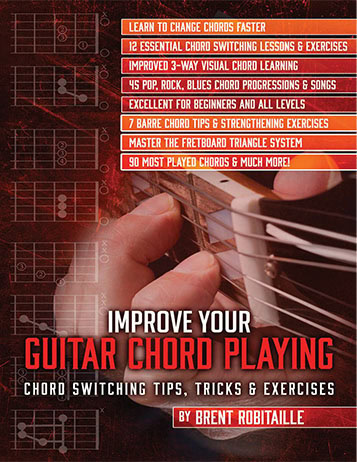
Stuck on the changes? This is the whole focus of my book Improve Your Guitar Chord Playing, where I drill switching with exercises and 45 of the most-used progressions in pop, rock, folk, and blues.
Improve Your Chord Playing →Standard guitar tuning chart
All the chords on this page assume standard tuning (E A D G B E), from the lowest/thickest string to the highest/thinnest string. If your chords sound wrong even with the right fingering, check your tuning first.
| String | Note | Played |
|---|---|---|
| 6th (thickest) | E | Low E |
| 5th | A | A |
| 4th | D | D |
| 3rd | G | G |
| 2nd | B | B |
| 1st (thinnest) | E | High e |
Exploring altered tunings like Open D, Open G, DADGAD, or Drop D? Those have their own chord shapes. Find them on the Open Tunings Guitar Learning Path.
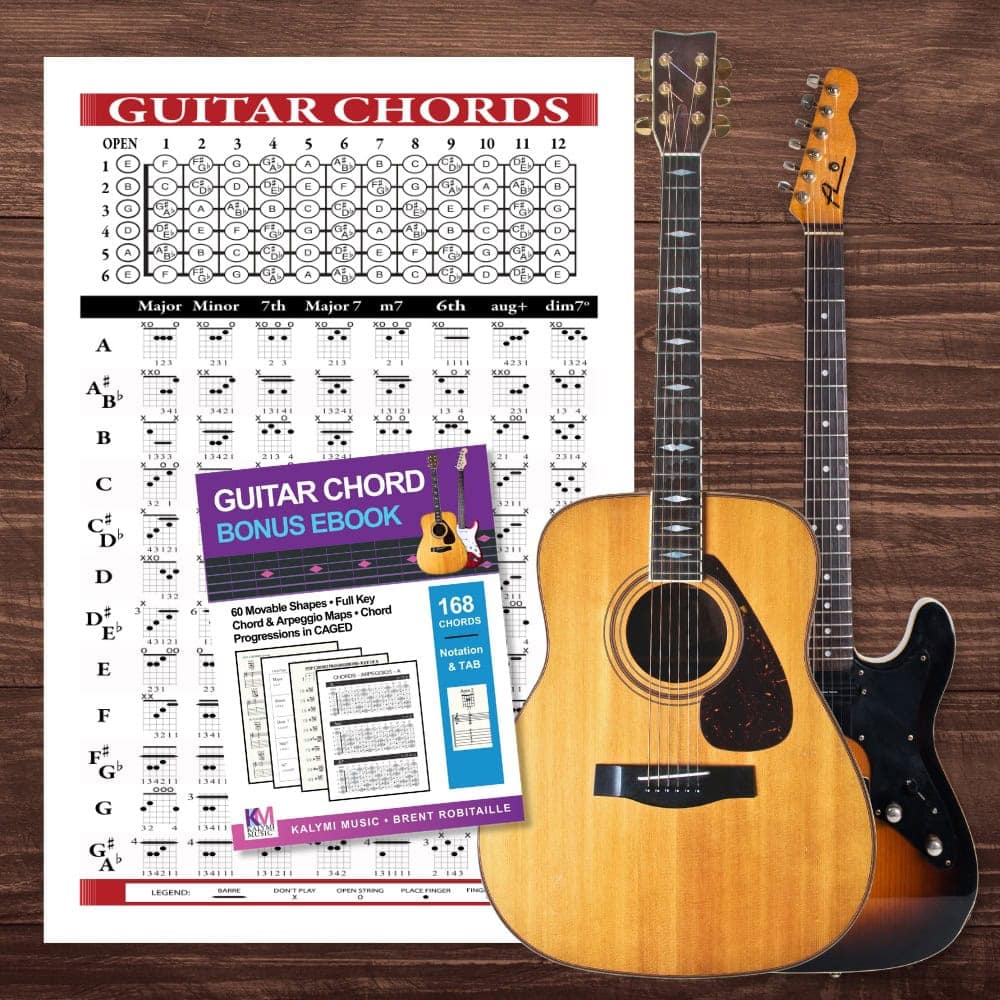
Ready to take the chords off the screen? The Guitar Chord Poster + eBook includes a printable 96-chord poster plus a 30-page eBook with 168 total chord diagrams, movable shapes, fretboard and arpeggio maps, and the top pop progressions in every key.
Get the Chord Poster →More guitar posters from Kalymi Music
The standard chord poster is one of a whole family of printable references. If you play a particular style or tuning, these go deeper, and each one comes with a free bonus PDF.
 Blues Guitar Poster
60 blues chords, 25 scales, and a free Daily Blues Warmup PDF.
Blues Guitar Poster
60 blues chords, 25 scales, and a free Daily Blues Warmup PDF.
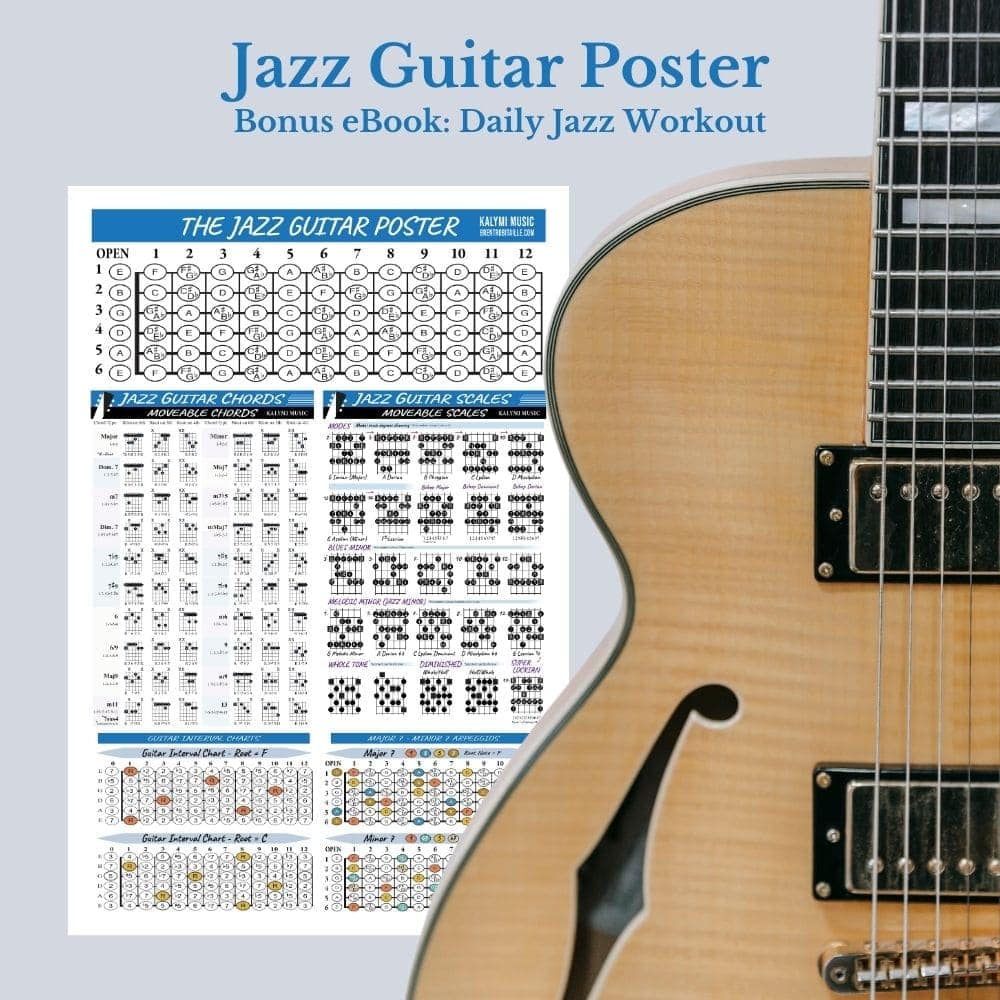 Jazz Guitar Poster
60+ jazz chords, scales, modes, and a free Daily Jazz Workout PDF.
Jazz Guitar Poster
60+ jazz chords, scales, modes, and a free Daily Jazz Workout PDF.
 Drop D Chord Poster
56 Drop D chords plus a 15-page, 92-chord bonus eBook.
Drop D Chord Poster
56 Drop D chords plus a 15-page, 92-chord bonus eBook.
Browse all music posters for guitar, ukulele, mandolin, and more →
Write down what you learn
The fastest way to remember a chord progression or a riff is to write it out. Keeping a few blank tab sheets nearby turns practice into a record you can come back to, and a practice planner helps you keep a steady practice routine.
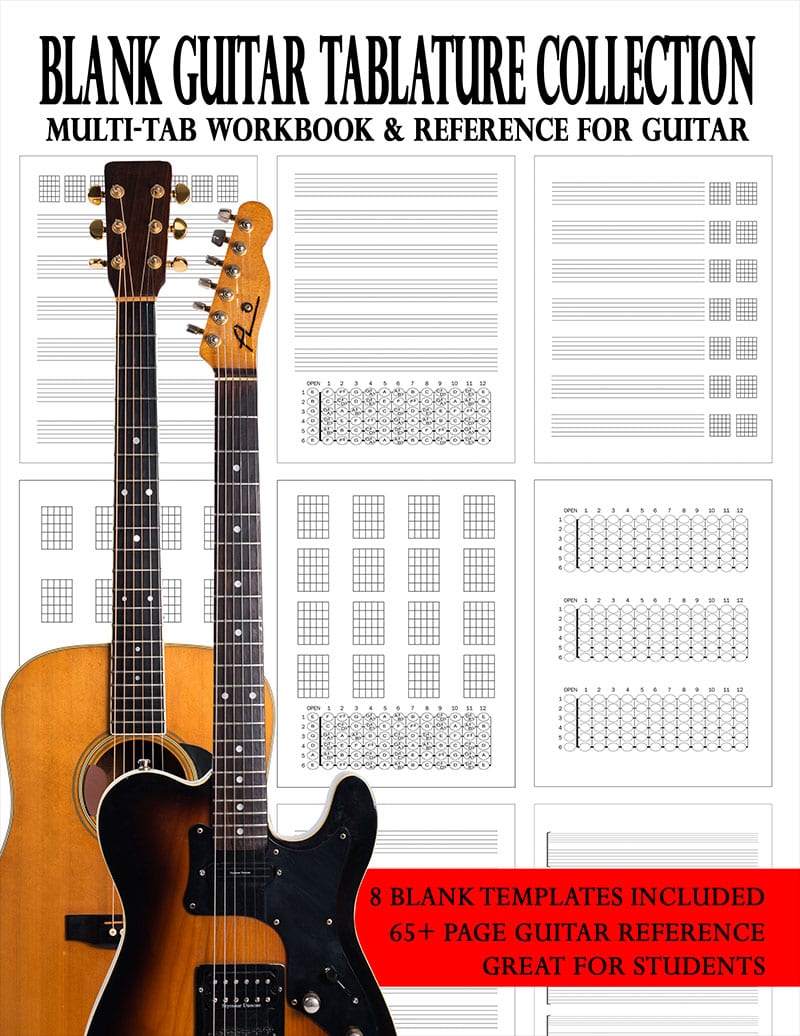
Need blank sheets? The Blank Guitar Tablature Collection gives you eight printable tab and notation templates plus a handy chord, scale, and fretboard reference.
Blank Tab Collection →Guitar chords: common questions
What are the basic guitar chords for beginners?
The most useful beginner chords are C, A, G, E, and D, plus the minors E minor, A minor, and D minor. Learn those eight and you can play a huge range of pop, folk, and rock songs.
What order should I learn guitar chords in?
Start with E minor and A minor because they use only two fingers each. Then learn E, A, and D. After that, add G and C, which need a bigger stretch. Add B7 and the other seventh chords once the open shapes feel comfortable.
What are the easiest guitar chords to play?
E minor and A minor are usually the easiest. They use two fingers and let the open strings ring. E major and A major are close behind.
How do I read a guitar chord diagram?
Vertical lines are strings, horizontal lines are frets, and the thick top bar is the nut. Dots show where to press, numbers tell you which finger to use, O means play the string open, and X means don't play that string.
What is standard guitar tuning?
Standard tuning is E A D G B E, from the thickest 6th string to the thinnest 1st string. Every chord on this page is built for standard tuning.
Why do my chords sound buzzy or muted?
Usually it's finger placement or pressure. Press just behind the fret rather than on top of it, arch your fingers so they don't touch neighbouring strings, and make sure your tuning is correct before blaming the chord.
Where can I find open tuning chords?
Open D, Open G, DADGAD, and Drop D use different shapes from standard tuning. You'll find those on the Open Tunings Guitar Learning Path.
Keep going
