

Guitar Dictionary Category
Slide, Resonator & Steel Guitar
What Is a Guitar Slide?
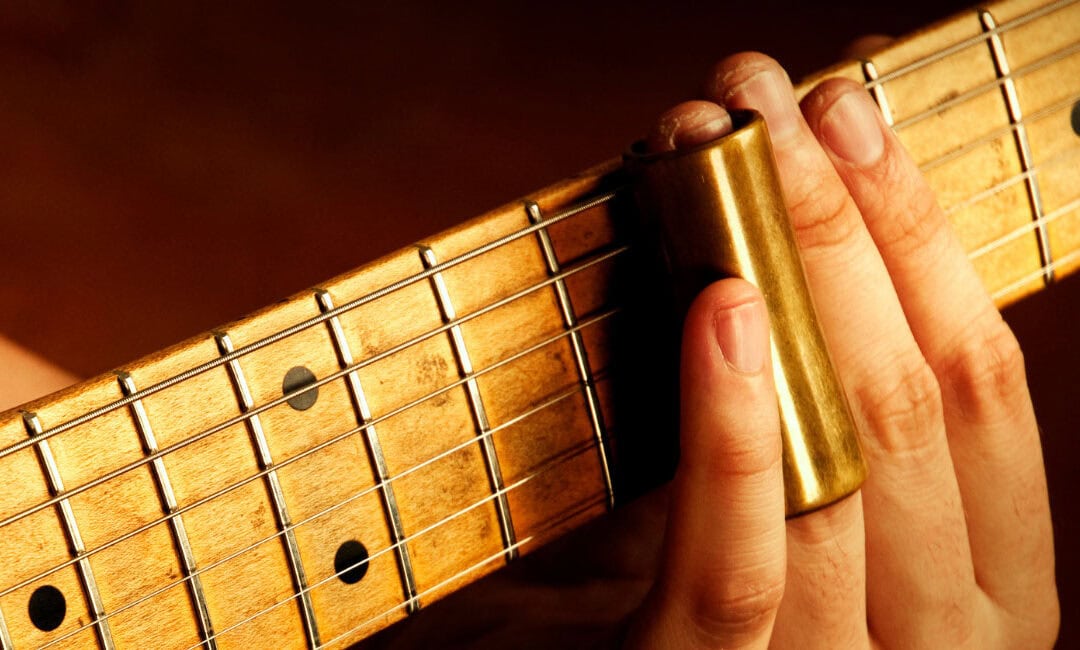
A guitar slide is a smooth tube worn on a fretting-hand finger or a solid bar held in the hand. It contacts the strings without pressing them to the frets and allows the player to move continuously between pitches.
Tubular slides are common on conventional guitars and cigar box guitars. Solid steel bars are used mainly for lap steel, squareneck resonator and other instruments played horizontally.
Common Slide Materials
- Glass: smooth attack, relatively light weight and a rounded tone.
- Brass: heavier feel, strong sustain and a bright, substantial attack.
- Steel: clear, bright and usually lighter than a comparable brass slide.
- Ceramic: available in many weights and surfaces, often between glass and metal in character.
- Bone or stone: less common materials with their own weight and texture.
Material affects the sound, but weight, wall thickness, string gauge, guitar action and the player’s touch matter just as much.
Fit and Finger Choice
A slide that is too loose rotates and makes accurate stopping difficult. One that is too tight restricts movement. The ring and little fingers are common choices, but the middle finger is also used.
The little finger leaves more fingers available for ordinary fretting. The ring or middle finger may provide greater strength and stability. Choose the position that supports the music you actually play.
Length and Coverage
A full-length slide can cover all six strings. A shorter slide is lighter and makes it easier to combine slide notes with fretted notes. Lap-style bars are shaped for grip, straight-bar chords, pull-offs and reverse movement.
Open- and Closed-End Slides
An open-ended slide may feel lighter and allows the fingertip to extend through it. A closed-end slide can distribute pressure differently and may protect the fingertip. Neither design is inherently superior.
Choosing a First Slide
Try several sizes and materials on the same guitar. Test single notes, two-string intervals, vibrato and silent movement. A slide that sounds impressive but cannot be controlled is not the best choice.
Why the Guitar Slide Matters
The slide is the physical connection between the hand and the strings. Its mass, fit and surface affect intonation, sustain, noise and comfort, but technique remains more important than the price or material.
Kalymi Tip
My slide lessons recommend experimenting until you find the right fit, thickness and tone. Do not choose a slide only because a favourite player uses that material.
Start with a slide that stays stable without squeezing the finger. Test it on the guitar you will actually use, because string height and gauge change how much weight feels comfortable.
A short glass or ceramic slide can be practical when you want to combine slide and fretted notes. A heavier full-length slide may be better for sustained full-chord work.
Related Terms
Learn More
- 6 Essential Skills on How to Play Slide Guitar Like a Pro
- Learn Sleepwalk Plus 10 Slide Tips
- Slide Guitar Collection
- Top 12 Resonator and Lap Steel Tips
- Open Tunings Guitar Learning Path
- Guitar Learning Path
Reviewed by
Brent C. Robitaille,
music educator and founder of
Kalymi Music.