
Guitar Dictionary Category
Notation & Reading
What Does PIMA Mean on Guitar?
PIMA is the common classical and fingerstyle guitar system for naming the picking-hand fingers. The letters come from Spanish finger names:
- p — pulgar, thumb
- i — índice, index finger
- m — medio, middle finger
- a — anular, ring finger
The little finger is used much less often. Some methods identify it with c or another editorial abbreviation, but p–i–m–a remains the core system.
Where PIMA Appears
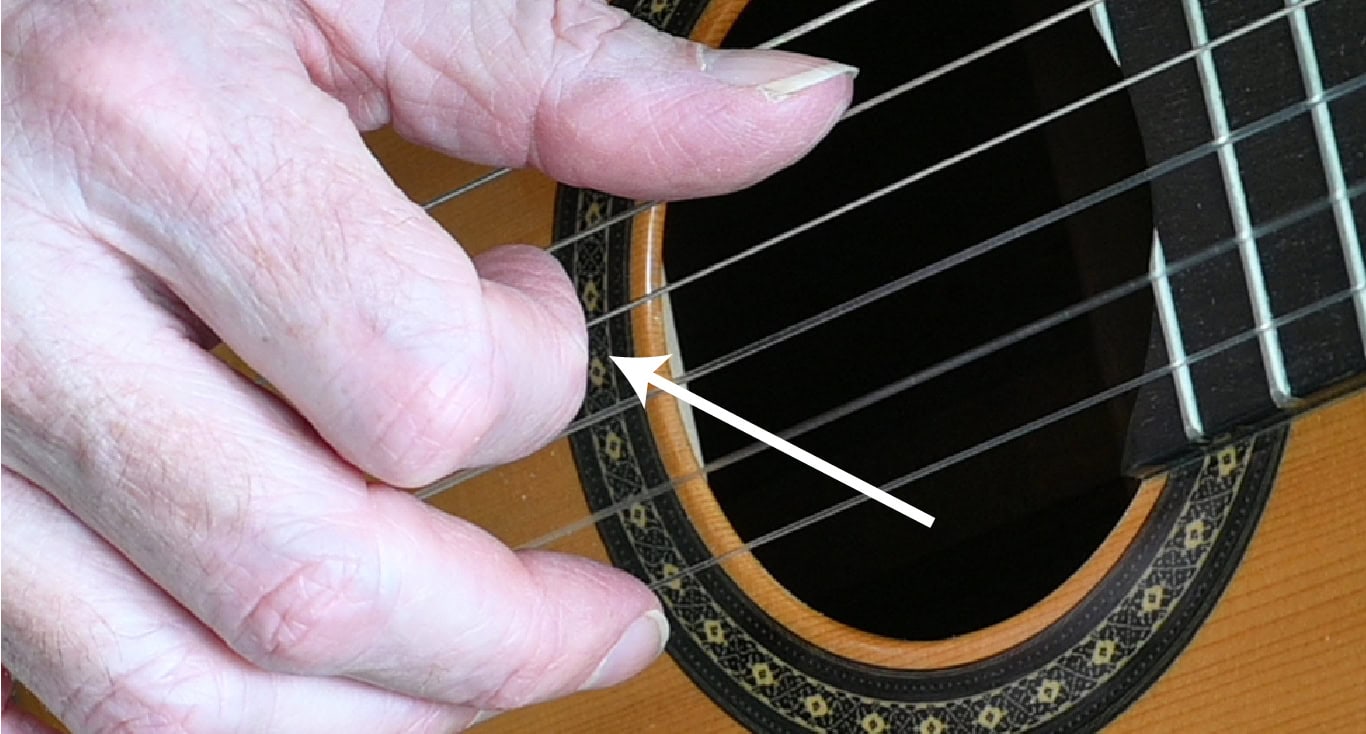
The letters are printed beside or above notes in standard notation, TAB, exercises and fingerpicking patterns. They tell the player which finger should produce each attack. They do not identify the string or fret.
A written sequence such as p–i–m–a describes finger order. In an arpeggio, p may play a bass string while i, m and a play successively higher strings.
Common String Assignments
As a starting point, p commonly handles the sixth, fifth and fourth strings, while i, m and a work mainly on the treble strings. These are practical defaults, not permanent restrictions. Scales, melodies, repeated notes and cross-string passages require the fingers to move.
Alternation and Repetition
For a scale or melody, alternate i and m instead of repeating one finger automatically. Practise starting with either finger. For arpeggios, keep each finger assigned long enough to learn the pattern, then apply the same movement to several chords.
Repeating the thumb is normal in many bass patterns. Repeating a finger can also be intentional when the tempo, tone or string arrangement supports it.
PIMA Exercise
Count: 1 & 2 & 3 & 4 &
Finger: p i p m p i p a
Strings: 5 3 4 2 5 3 4 1
Keep the thumb steady and make the finger notes fit around it. Then move the pattern through G, Am and F without changing the rhythm.
PIMA vs Finger Numbers
PIMA belongs to the picking hand. The numbers 1–4 belong to the fretting hand. A score may show both systems around the same note because one symbol selects the attack and the other selects the stopped position.
Why PIMA Matters
PIMA provides a precise language for teaching fingerstyle coordination. It lets a player analyse patterns, correct inefficient repetitions and preserve a successful fingering across practice sessions.
Kalymi Tip
Use p, i, m and a as functional assignments rather than as rigid string ownership. My classical guitar lesson begins with the thumb on the bass strings and i–m–a on the upper strings, then expands those roles as the music requires.
Prepare the fingers before the notes sound. Hover or lightly plant the upcoming finger over its string while the previous group is being played. This reduces searching and helps the rhythm remain steady.
Practise a pattern on one chord until the finger order is automatic, then change the harmony without changing the right hand. Finally, reverse or vary the pattern so you understand the coordination rather than memorizing only one sequence.
Related Terms
Learn More
- How to Play Classical Guitar: Lesson One
- Guitar Fingerpicking Poster
- Cigar Box Guitar Fingerpicking Lesson
- Mastering Fingerstyle Ukulele Companion
- Guitar Learning Path
- What Is PIMA?
Reviewed by
Brent C. Robitaille,
music educator and founder of
Kalymi Music.