
This lesson explores a roots blues approach for 3-string cigar box guitar, part of my ongoing roots blues series.
It’s a 12-bar blues in G, played twice through (24 bars total), with variations on the second pass. I played this one fingerstyle, with the guitar tuned to standard open G: GDG.
There are 25 unique blues riffs that you can work on and use in your own blues jams. In the first video, I play the piece at a slow, bluesy tempo. In the second video, I will play all 25 riffs one at a time, repeating each 3 or more times at a slightly slower tempo. Both videos show the tab and a close-up of both hands on the CBG.
If you’d like a copy of the tab, I’m providing a free PDF download for Roots Blues #3. Please leave an email address in the form below so I can send it to you.
The lesson below breaks down the piece so you can hear the rhythm and watch the finger placements. I also explain what roots blues is and outline the key moments in the history of the style. One of the main teaching ideas in this lesson is how call and response works on more than one level in roots blues, and this piece is a clear example of that approach.
📋 What’s in This Lesson
- Video Lessons – Full performance and riff-by-riff breakdown
- Free PDF Tab Download
- Call and Response Explained – Two-level approach
- Adding Variety – Keep the second chorus interesting
- Key Techniques – What you’ll learn
- Blues Turnaround & Ending
- What Is Roots Blues?
- Blues Lineage Timeline – 1900 to present
- More CBG Resources
- Common Questions
🎸 New Cigar Box Guitar Book Coming Soon
I know you’re here for the blues jam, but I wanted to let everyone know I’m releasing a new cigar box guitar book very soon.
The latest book is called Cigar Box Guitar Country & Bluegrass Book. I’ve spent the last few months assembling what I think will be my best CBG book yet. Whether you’re a country or bluegrass fan or not, there’s a lot to learn that applies directly to blues, rock, and most styles that require improvisation, chords, scales, and technique.
🎥 Video Lessons
🎥 Video Lesson #1
Full performance of the roots blues piece from start to finish.
🎥 Video Lesson #2
Riff-by-riff breakdown played slowly for practice and study.
The whole piece is presented at tempo first, then each riff is played slowly. I repeat each riff at least three times so you can hear the rhythm and watch the finger placements.
📥 Download the Free PDF Tab
Want the complete tablature for Roots Blues #3?
Fill out the form, and I’ll send it straight to your inbox.
• LEARNING PATH
Cigar Box Guitar: The Complete Learning Path
A structured path through lessons, repertoire, and reference material
for 3-string, 4-string, and 2-string cigar box guitar.
- Beginner to advanced progression
- Free lessons and guided repertoire
- 3-string, 4-string, and 2-string covered
What’s Happening in This Roots Blues Piece
When I started taking a closer look at what’s actually happening in this piece, I realized there was more going on than I first thought. On the surface, it sounds like a straightforward call and response roots blues riff, but there are several layers of that back and forth working together.
Call and Response in Roots Blues (Two Levels Explained)
At a larger level, the piece uses register-based call-and-response. In this piece, the opening riff, or motif, is played in the higher register and acts as the call. That phrase is answered immediately by a low blues bass figure. This kind of high followed by a low-register response is common in roots blues.
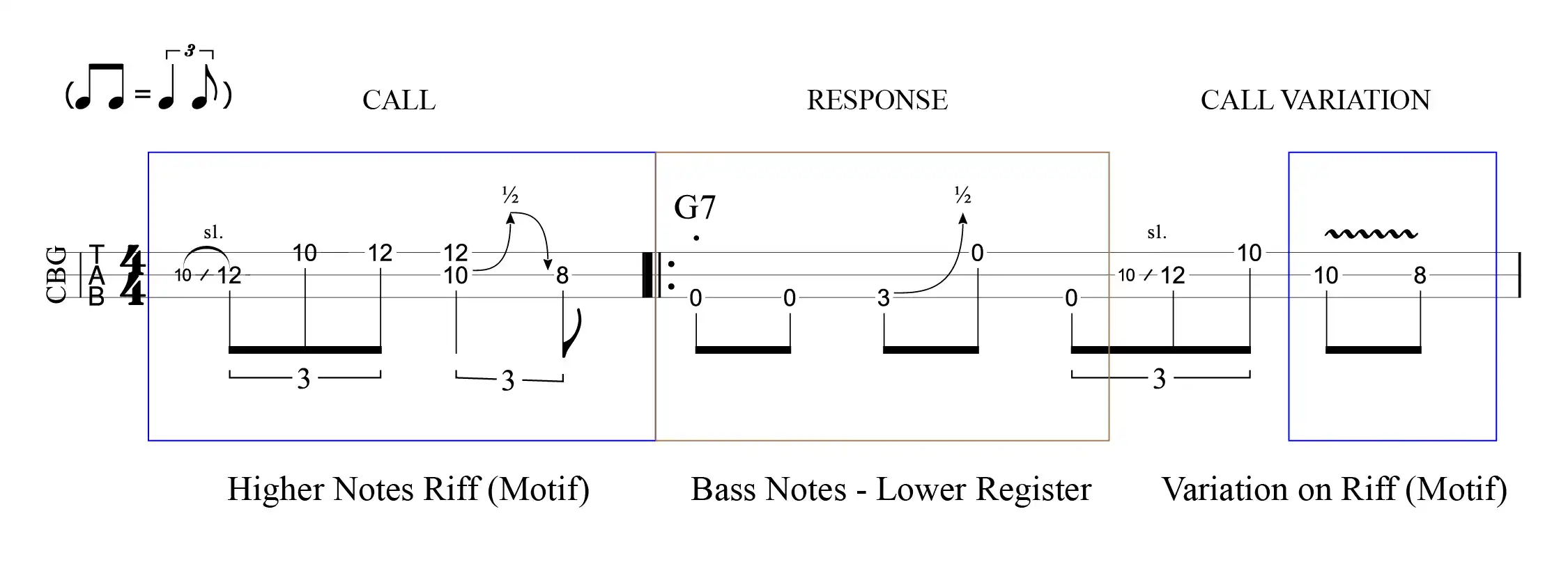
But what makes this lesson more interesting is what happens inside the riff itself. In bar two, the original motif is not simply repeated. Instead, it is answered by a slightly changed version of the same idea. This creates a second layer known as motivic call-and-response, in which a musical idea responds to itself through repetition and variation. In simple terms, create a riff, then add variations.
Here is the workflow to build your own blues jams:
- Create a riff (motif) on the higher-pitched notes (Call)
- Play a bass-type riff on the lower-pitched notes (Response)
- Use a variation on the first riff (motif variation)
By working with call and response on two levels, between registers and within a simple riff, you can create movement and shape without adding more notes or chords. That kind of musical conversation sits at the center of much roots blues playing.
Once that basic conversation is underway, the next step is relatively simple. Add more variations without changing the riff too much the second time through the form.
Adding Variety to a Roots Blues Jam
Up to this point, the focus has been on how call-and-response shapes the groove. Another way to get more mileage out of the same ideas is by adding variety the second time through the form. Typical ways to add variety are:
- Alter the rhythm of the original riff,
- Change a few notes, add a double stop, or briefly grab a barre shape.
- As always, trills, triplets, hammer-ons, pull-offs, slides, etc.
- Subtle bass movement or walking bass.
Therefore, the goal is not to play something completely different, but to continue developing the original motif. In music school, I often heard criticism that you can always tell a beginner player because they add way too much! Keep it simple, it worked for Beethoven, so….

🎸 Key Techniques in This Jam
- Steady shuffle rhythm feel built on triplets
- Fingerstyle bass and melody independence
- Register-based call and response
- Slides for vocal phrasing
- Hammer-ons and pull-offs for flow
- Light bends and vibrato for expression
The Blues Turnaround
A turnaround is the short phrase at the end of a blues form (bars 11-12) that leads the music back to the beginning. In this turnaround, I use a simple chromatic movement to pull the sound back to G7 by adding the Eb7. The shift from Eb7 to D7 adds tension, while the added triplet feel varies the rhythm:

The Blues Ending and Final Resolution
At the end of the piece, the harmony takes a short detour based on the earlier turnaround by adding a diminished and minor chord.
The Bb diminished chord works as a passing chord, creating a bit of tension and helps guide the ear smoothly into Cm.
That Cm chord is a subdominant minor, borrowed from the key of G minor. This adds a darker colour, giving the ending a more expressive, blues-heavy finish.

To put these ideas in context, it’s worth stepping back and asking a simple question: what is roots blues, and why does this early, foundational style still shape the way blues is played today?
My first real exposure to roots blues came as a teenager when I bought a Robert Johnson Delta blues album. Learning those early riffs had a lasting influence on how I play and write music, and I still hear traces of that approach in my playing today.
What Is Roots Blues?
Roots blues is an early, acoustic style of blues built around simple song forms, steady rhythm, improvisation, and raw emotion. It grew out of rural Southern music traditions in the early 1900s and is typically played using fingerstyle technique, open tunings, and call-and-response phrasing.
While many roots blues tunes use a loose 12-bar structure, the form is often flexible, shaped by the vocal line and rhythm. Roots music relies on feel and expression, using slides, bends, hammer-ons, pull-offs, and vibrato to give each note real depth.
🎼 Roots Blues Lineage (1900–Present)
ROOTS & EARLY COUNTRY BLUES (1900–1930)
Blues music began as a blend of field hollers, ragtime, spirituals, and early folk traditions.
Key figures:
- W.C. Handy is often called the “Father of the Blues” because he helped document and publish blues music for more people to hear.
- Blind Lemon Jefferson was the first national blues guitar star. His Texas style helped shape the tradition of solo blues musicians.
- Lead Belly connected folk, prison songs, and blues, and was a master of the 12-string guitar.
- Henry Thomas was one of the first blues musicians to be recorded, representing songster traditions from the late 1800s.
DELTA BLUES (1910s–1940s)
Delta blues started in the Mississippi Delta and is known for its raw, personal style and strong rhythms. It features bottleneck slide guitar, strong rhythmic bass, and very expressive singing.
Key figures:
- Charley Patton is often seen as the father of Delta blues.
- Son House was famous for his intense slide guitar playing and sermon-like singing.
- Robert Johnson developed Delta blues into a guitar style that influenced many musicians.
- Skip James was known for his Bentonia style, minor tunings, and haunting vocals.
PIEDMONT & EAST COAST BLUES (1920s–1950s)
This style is lighter and more upbeat, influenced by ragtime and early jazz.
Key figures:
- Blind Blake was known as the king of ragtime blues guitar.
- Blind Boy Fuller was the most popular Piedmont blues artist of the 1930s.
- Rev. Gary Davis bridged gospel and blues fingerpicking.
- Elizabeth Cotten was famous for her left-handed “Cotten picking” style.
TEXAS & SOUTHWEST BLUES (1930s–1950s)
This period marked a shift from acoustic country blues to jazz-influenced electric and jump blues.
Key figures:
- T-Bone Walker pioneered electric blues guitar.
- Lightnin’ Hopkins kept Texas blues raw across acoustic and electric eras.
- Big Mama Thornton bridged Texas blues and early rock and roll.
HILL COUNTRY / NORTH MISSISSIPPI BLUES (1940s–Present)
This style focuses on hypnotic grooves and fewer chord changes.
Key figures:
- Mississippi Fred McDowell
- R.L. Burnside
- Junior Kimbrough
CHICAGO & URBAN ELECTRIC BLUES (1945–1970)
Delta blues amplified into a full-band sound during the Great Migration.
Key figures:
- Muddy Waters
- Howlin’ Wolf
- Little Walter
- Elmore James
BLUES REVIVAL & MODERN ROOTS (1960s–1990s)
A renewed interest in acoustic blues and global expansion of the genre.
Key figures:
- John Lee Hooker
- Sonny Terry and Brownie McGhee
- Taj Mahal
- Ry Cooder
- Stevie Ray Vaughan
CONTEMPORARY DIY / AMERICANA / CIGAR BOX (2000s–Present)
A return to raw sounds, homemade instruments, and early blues spirit.
Key figures:
- Seasick Steve
- Samantha Fish
- The Cigar Box Guitar Movement
❓ Common Questions
What tuning is used for this roots blues lesson?
This lesson uses standard open G tuning: G-D-G (low to high). This is the most common tuning for 3-string cigar box guitar and works perfectly for blues in the key of G.
Do I need to read music, or is tablature provided?
Tablature (tab) is provided as a free PDF download. You don’t need to read standard music notation. The videos show close-ups of both hands so you can see exactly where to place your fingers.
What's the difference between roots blues and Delta blues?
Roots blues is the umbrella term for early acoustic blues styles. Delta blues is one specific regional style within roots blues that originated in the Mississippi Delta. Delta blues typically features slide guitar and intense, personal expression. This lesson uses roots blues techniques that work across multiple regional styles.
Can I play this on a 4-string cigar box guitar?
Yes! Just ignore the fourth string and play the melody and bass lines on the G-D-G strings. The concepts of call and response, variety, and turnarounds apply to any configuration.
I'm a beginner - is this lesson too advanced?
This lesson works for multiple skill levels. Beginners should focus on locking in the opening groove and learning one solid turnaround. More advanced players can work on all 25 riffs and add variations on the second pass. Take what works and build gradually.
How long will it take to learn this piece?
That depends on your current level. The basic groove can be learned in a single practice session. Mastering all 25 riffs with smooth transitions and variations might take a few weeks of regular practice. The riff-by-riff video (Video #2) breaks everything down slowly so you can work at your own pace.
• LEARNING PATH
Cigar Box Guitar: The Complete Learning Path
A structured path through lessons, repertoire, and reference material
for 3-string, 4-string, and 2-string cigar box guitar.
- Beginner to advanced progression
- Free lessons and guided repertoire
- 3-string, 4-string, and 2-string covered
Questions?
Drop a comment below. Now grab your cigar box guitar and work through those riffs.

Cigar Box Guitar Jazz & Blues 3-String eBook Bundle
Save 40%
- Learn jazz & blues on your 3-string cigar box guitar with this 3-book eBook bundle.
- Includes Jazz & Blues Unlimited Book One, Book Two, and the Complete Chord Book. $57.97 value — only $34.99 CAD (save 40%)!

3-String Cigar Box Guitar Chord and Fretboard Poster Set
Cigar Box Guitar GDG Chord Poster (3-String) + Bonus 8-Page eBook (180+)
- Instant bonus: download the eBook right after checkout, so you can start today.
- Poster size: 12×18 in. Easy to read from your stand or wall.
- Top banner: full-colour CBG fretboard to the 12th fret.
- On the poster: Major, minor, 7, m7, 6, maj7, 9, dim7 — 96 chords with fingerings.
- In the eBook: 180+ chords in all keys with five positions for Major, minor, and Dominant 7.
- Made by working musicians
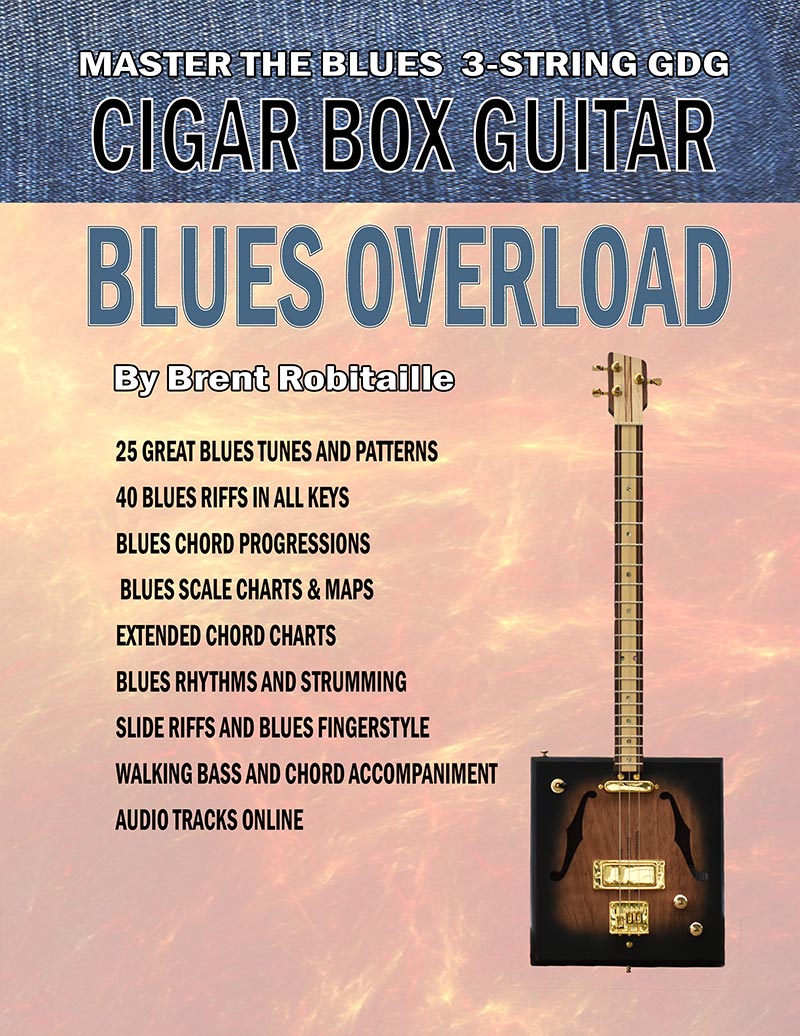
Cigar Box Guitar – Blues Overload
Master the blues. Everything you need to learn the blues on the 3 String Cigar Box Guitar (GDG). A complete blues method with over 330 pages! Including blues tunes, riffs, chord progressions, blues scales and much more. A must have for all cigar box guitar players. Audio tracks below.
Free companion page included: Access the Blues Overload audio downloads, backing tracks, video demonstrations, and book contents guide on the dedicated companion page.
Open the Blues Overload Companion Page
Part of the Cigar Box Guitar Learning Path: For a structured route through beginner lessons, blues, slide, fingerstyle, repertoire, and related books, visit the full learning path.
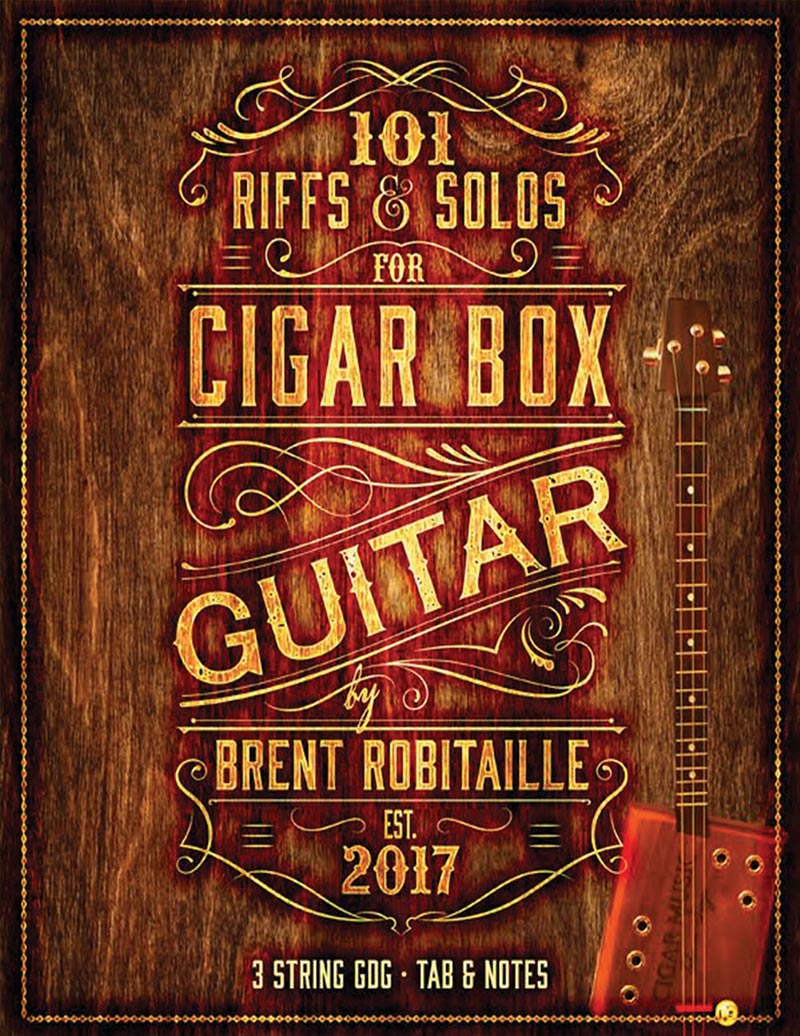
101 Riffs and Solos for 3-String Cigar Box Guitar
“101 Riffs and Solos” arranged for the 3-string fretted or fretless cigar box guitar tuned to GDG. An excellent resource for beginners and review of useful techniques for players of all levels and styles, including blues, rock, country, and popular. Audio tracks below.
Essential lessons for the cigar box guitar.
The Complete Cigar Box Guitar Chord Book
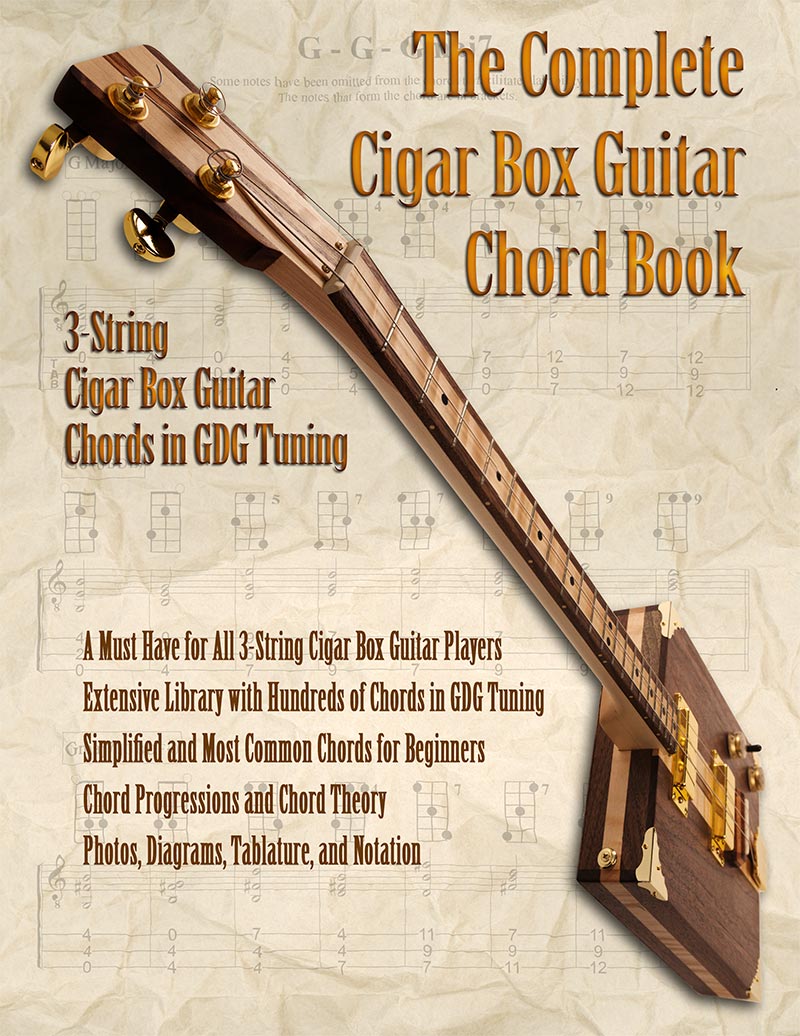
The Complete Cigar Box Guitar Chord Book is the most extensive library of chords ever assembled for the 3-string cigar box guitar. With over 2000 chords, chord progressions, strumming patterns and exercises included. Chords are shown with diagrams, tablature, notation, and some photos. A must-have for all cigar box guitar players.
3-String Cigar Box Guitar Chords in GDG Tuning
Wow, this Roots Blues Cigar Box Guitar Lesson is incredibly detailed and beginner-friendly! I love how Brent breaks down the 12-bar blues with both fingerstyle technique and the dual-layer call-and-response approach, making it easy to understand how the riffs interact across registers. The inclusion of 25 unique riffs and a free PDF tab makes practicing and creating your own blues jams so much more accessible.
Thanks for sharing such a thorough lesson combining historical context, technical insight, and hands-on practice!
Thanks, glad you enjoyed the lesson!