
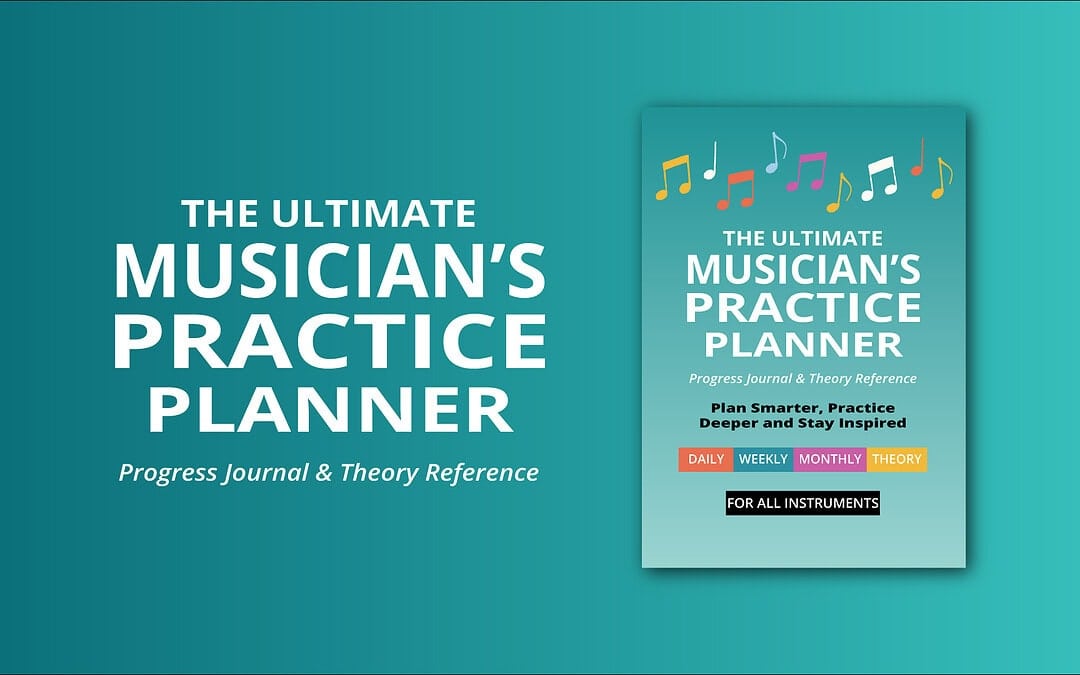
Most musicians do not quit because they lose interest. They quit because they cannot focus or they get too busy and run out of time. Professionals have the same issue. They are always learning new music, so it is easy to lose track of what they were working on. This is one of the reasons I created a music practice planner that helps players stay focused and organized.
I have seen this in students, other players, and in my own practice. You put in the time, but you are still not happy with your progress. You forget what you worked on, what got better, and what still needs work. After a while, the frustration takes over, and the joy of playing drops away. It does not have to be like this.
I created the Musician’s Practice Planner after many years of teaching and gigging. I made it to help students deal with everyday practice problems. This planner is based on what actually happens in a real practice session. It works on days when everything feels easy and on days when you cannot focus at all. If you want more detail on how warmups and technique fit into a structured session, here is my guide: Max Out Your Music Practice.
In this article, I will explain how musicians grow, why most practice routines fall apart, and how a simple system can help you make steady progress.
Along the way, I will also share a free Modes Circle download and a small bonus practice starter pack you can use with or without the planner. Research on deliberate practice also supports this kind of structured approach, and you can read a summary here: K. Anders Ericsson – Deliberate Practice.
Table of Contents
Why Musicians Struggle With Practice (Even After Years of Playing)
Many students today learn from YouTube or jump from post to post or book to book. It feels like progress, but most of the time it just creates scattered practice. Most practice problems fall into five categories:
- No Clear Direction: Asking “What should I work on today?” becomes a daily guessing game.
- Lack of Structure: It is difficult to move from warmups to technique to repertoire without a plan.
- Missing Feedback Loop: You cannot see what has improved because nothing is recorded.
- No Long-Term Connection: You might practice scales, but not understand why today’s scale matters.
- Unmeasurable Progress: Without tracking, motivation fades quickly.
Most musicians do not need more stuff. They simply need focus and time. Both time and focus come from a system you can return to day after day, something that guides your practice.
A Real Story from My Early Practice Years
When I first started playing guitar, I was seven. I liked the instrument, but that interest turned into a chore pretty fast. I grew up in a small town, and the only guitar teacher moved away. That was the happiest day for me because my parents finally stopped nagging me to practice.
Then the worst thing happened. A few months later, a new teacher moved into town, and my father signed me up again. I was not impressed. But that teacher did something different. He had me play with other students, and that changed everything. There was some peer pressure, a bit of competition, and suddenly I wanted to play. What my mother used to beg me to practice became more like, “Can you please stop playing!”
My point is that no planner will make you want to practice on its own. It can help you stay organized and keep track of what you are doing, but above all else, you need your love of music and a real reason to sit down and play.
Most musicians do not need more practice time. They need a clear plan.
If you want ideas on how to structure warmups and technique work, I have a complete guide here:
Max Out Your Music Practice
Further Reading: The Science of Progress
Research shows that focused, structured practice is far more effective than simply practicing more. You can read a summary of psychologist K. Anders Ericsson’s work on deliberate practice here: K. Anders Ericsson Research Summary

A Planner Designed by a Working Musician, For Musicians
I built this planner the same way I have written all my music books. I tested ideas with my own students, did the research, rewrote almost everything, and then tested it again in real lessons. Over the years, I kept notes on sticky pads, scraps of paper, the back of charts, and whatever was close at hand. For some reason, I never bought a proper notebook to keep track of things. A lot of musicians do the same — we think we can hold it all in our heads.
I cannot say this planner will solve every problem you have with practice, but it does give you a simple system to follow. After years of teaching and playing, this is the closest thing I have found to a real musician’s companion — not just another notebook.
If you want to see the full planner details, you can view it here:
Musician’s Practice Planner
Get the Musician’s Practice Planner
One of the most useful theory tools I use in my books and courses is the Modes Circle. Most musicians have seen the Circle of Fifths, and for a while I tried to create a full circle of modes as well. It quickly became too complex, so I kept it practical. The Modes Circle shows each mode in relation to its parent major key, which makes it easier to understand and helps you hear why each mode sounds the way it does.
The Modes Circle is printed inside the planner, and I am offering it here as a free download (no email required). If you want the complete Modes Cheat Sheet showing every mode in all major and minor keys, you can get it in the Bonus Email Pack further down this page.
FREE Download:
Modes Circle PDF

Introducing the S.O.U.N.D. Framework
If you keep these five elements in mind while you practice, you can develop a clear path forward. The S.O.U.N.D. Framework is a simple goal-setting system inspired by the SMART method and tailored specifically for musicians.
S – Simple
Choose one clear goal for your practice session. Avoid multitasking and stay with one idea. If the focus is on scales, work on scales, not tone. If the focus is on repertoire, stay with the piece rather than your arpeggios. A single, simple task helps you concentrate and make faster progress.
O – Observable
Work on something you can clearly measure or hear improving. Ask yourself simple questions such as, “Did my chords improve, and how can I tell?” You might notice a cleaner tone, steadier rhythm, smoother transitions, or fewer hesitations. When your progress is observable, you know you are moving in the right direction.
If you want to understand how your brain actually develops repeating skills, here is my article on muscle memory in music.
U – Useful
Choose goals that actually move you forward. A worthwhile goal strengthens the pieces or techniques you need, not the ones you have already mastered. Ask yourself, “Is this the best use of my practice time, or am I avoiding the skill that really needs attention?”
N – Natural
Select goals that make sense for where you are and where you want to go. Ask yourself, “Does this goal match my ability today?” and “Will this help me move toward my long-term musical goals?”
D – Dated
Set a small deadline or review date for your goal. Even a short timeline helps you stay focused and prevents your practice from becoming vague or open-ended.
The S.O.U.N.D. Framework can be applied throughout the planner, giving you a structure to return to each day and helping you build steady, reliable progress. When you keep these five ideas in mind, practice becomes clearer and easier to manage.
Why Musicians Use a Music Practice Planner
A music practice planner gives you a simple way to stay organized and see real progress. When you write down what you are working on and why, your practice becomes clearer and easier to manage. Over time, this kind of structure makes a big difference in how you play and how you feel about your music.
A Look Inside the Musician’s Practice Planner
This planner is built as a full practice system, not just a set of daily pages. It gives you a place to set goals, track your work, stay organized, and build long-term progress. Here is a quick look at what is inside.
Foundations and Setup
A clear starting point for your practice cycle. Use this section to:
- Set your long-term goals and outline your technique work.
- List your Repertoire, track Creative Ideas, and use logs for Gigs, Gear, and Projects.
- Features a blank calendar to help you plan your practice cycle.
The Practice System
The core of the planner. It runs on a 28-day cycle with:
- Dedicated **Daily, Weekly, and Monthly pages** for structured tracking.
- Track Warmups, Technique, Repertoire, Creativity, and Reflections.
- Includes space for **Teacher Notes** if you take private lessons.
- Designed for continuous, reliable practice, day after day.
End of Season Review
A simple review to close out your practice cycle:
- Helps you clearly see what improved and what needs attention in the next cycle.
Theory and Reference
A full set of quick reference tools, saving you time during practice:
- Includes charts for Key Signatures, Circle of Fifths, Chord Formulas, Inversions, and Scale Charts.
- Features reference guides for Modes, Improvisation Maps, Intervals, and Rhythm Charts.
Creative and Notes Section
A place to explore ideas and save important information:
- Includes pages for Music History notes, a Glossary, Lined Pages, and Manuscript Pages.
- Extra space for anything you want to remember or work on.
Bonus Full Major/Minor Mode Cheat Sheet
If you want a few extra tools to help you get started, I put together a small Bonus Practice Pack you can receive by email. It includes several charts I use every day when teaching and practicing.
Included in the pack:
- Intervals Chart
- Scale Formula Sheet
- The full Modes Cheat Sheet in major and minor keys
You can sign up below to receive the pack.
Your privacy is 100% guaranteed. We will never share your email. You will only receive occasional updates related to music and practice that match your interests.
Sign up to get the Mode Cheatsheet download:
Works for Any Instrument
A good practice system shouldn’t lock you into one instrument, and this music practice planner works for all levels and styles. Whether you play stringed instruments, keys, voice, or multiple instruments, the same structure helps you make steady progress.
• Guitar
• Ukulele
• Mandolin
• Fiddle
• Banjo
• Piano
• Bass
• Cigar box guitar
• Voice
• Songwriters
• Multi-instrument musicians
A sound practice system shouldn’t limit you. Beginners, intermediate players, and advanced musicians can all use the same structure and adapt it to their needs.
A Tool You Return To, Not Shelf After a Week
The Musician’s Practice Planner is not meant to stay clean. It’s meant to be used. You write in it, cross things out, carry it around, and make it part of your practice.
Musicians who use it regularly often say they get:
- More consistent practice
- Clearer goals
- Faster technical improvement
- Better motivation
- Less overwhelm
- Stronger progress with repertoire
- A better sense of who they are as players
I do not believe in mastery. I believe in integrity. If you feel connected to the music, it does not matter if you made a mistake or if your tone was not perfect. What matters is that you showed up and stayed honest with your playing.
You will have off days. Everyone does. Progress is never a straight line. But when you step back and look at the longer view, you see the truth:
The overall direction is still rising.
The goal is not perfection. The goal is steady progress.
Get the Musician’s Practice Planner
Most musicians want progress, not more practice hours. A simple, focused music practice planner can make the difference between feeling stuck and seeing steady growth.
If you’re ready to bring more clarity, structure, and motivation to your practice routine, you can order the planner here:
Musician’s Practice Planner – The Ultimate Musician’s Practice Planner | Theory Reference

Choose Your Format
Same practice system. Choose the format that matches how and where you practice.
Tablet Planner (Instant Download)
Write directly on your iPad or tablet with a stylus. Your notes save automatically, with built-in bookmarks for fast navigation. Start using the planner immediately after purchase.
Tablet-optimized PDF with full practice system and theory reference.
Paperback B/W Edition
Lighter and more affordable with the same layout and content. A good choice if you like starting a fresh planner every year.
Interior: Black & white practice pages with full theory section.
Hardcover B/W Edition
Durable and bookshelf ready. Ideal for studios, teachers, and musicians who plan to reuse the planner structure year after year.
Interior: Black & white practice pages with integrated theory reference.