

Guitar Dictionary Category
Scales, Melody & Improvisation
What Is a Guitar Riff?
A riff is a recognizable musical idea that repeats or returns as part of a song, groove or instrumental section. It may be a single-note melody, a chord figure, a bass pattern, a rhythmic phrase or a combination of these elements.
A strong riff often helps identify the music immediately. It can function as an introduction, verse foundation, recurring hook, accompaniment pattern or call-and-response idea.
Riff vs Lick
A lick is usually a short vocabulary phrase used inside a solo, fill or transition. A riff is more likely to carry a section or return as part of the arrangement. The distinction is useful but not absolute; a short phrase can become a riff if the music repeatedly builds around it.
A riff is also related to an ostinato, which is any persistently repeated musical pattern. “Riff” is the more common term in blues, rock, metal, funk and roots guitar.
What Makes a Riff Memorable?
Pitch is only one part of the design. Rhythm, rests, accents, articulation, register and tone may be more important than the number of notes. Many classic riffs use a small pitch collection but place it in a distinctive groove.
A useful test is to tap the rhythm without the guitar. If the idea loses all identity when the pitches disappear, its rhythmic character may need strengthening.
Learning a Riff Accurately
Separate the riff into rhythm, fretting and articulation. Clap or count the rhythm first. Learn the notes at a slow tempo. Add slides, hammer-ons, pull-offs, bends and palm muting only after the timing is secure.
Use a metronome, drum pattern or backing track. A riff that sounds correct in isolation may rush before a rest or drag during a position shift.
Riff Variation Exercise
Write or learn a one-bar riff. Repeat it four times while changing only one element:
- Original version.
- Change the final note.
- Keep the notes but move one accent.
- Add a rest and answer the gap with a shorter phrase.
This develops variation without destroying the identity of the idea.
Riffs in Improvisation and Composition
A riff can become the subject of a complete solo, loop or song section. Instead of abandoning it after one statement, transpose it, shorten it, sequence it or answer it in another register.
When borrowing a traditional or widely used vocabulary pattern, transform it through rhythm, harmony and phrasing. Do not assume that changing one note automatically creates an original composition.
Why Riffs Matter
Riffs connect rhythm, melody and technique in a compact form. They give beginners recognizable material to practise and give advanced players a structure that can be developed across an arrangement.
Kalymi Tip
Learn a riff accurately, then change one rhythmic value, one ending note or one accent. That small variation teaches how musical vocabulary becomes a new idea without losing the original shape.
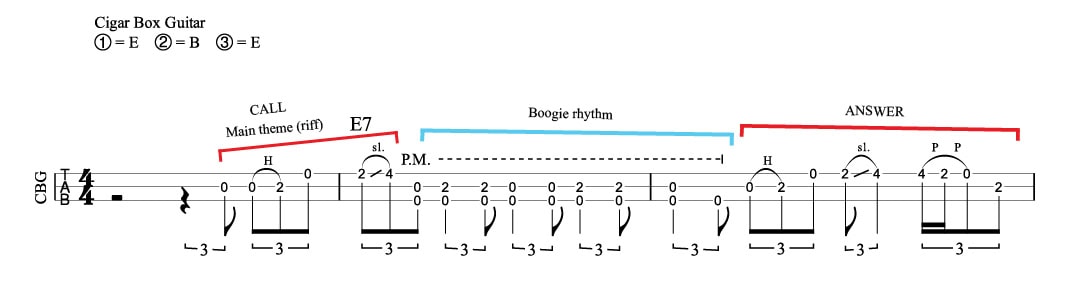
In my “Hide Away” lesson, the main figure is presented as a call, boogie rhythm and answer. Use the same approach with your own material: state the riff, create space or accompaniment, then return with a recognizable variation.
Keep the pulse steady while you experiment. Use a metronome or drum pattern and record several versions. The strongest variation is not necessarily the busiest one; it is the version that preserves the identity while giving the listener a reason to hear it again.
Related Terms
Learn More
- Open E Cigar Box Guitar and Blues Tutorial
- Roots Blues Cigar Box Guitar Lesson
- Top 10 Grunge Riffs on 3-String Cigar Box Guitar
- 101 Riffs and Solos for Cigar Box Guitar
- Open D Blues Riffs and Solos Companion
- Cigar Box Guitar Tabs
Reviewed by
Brent C. Robitaille,
music educator and founder of
Kalymi Music.