
Guitar Dictionary Category
Chords & Harmony
What Is a Turnaround in Guitar Music?
A turnaround is a short melodic or harmonic passage near the end of a section that leads back to the beginning or into the next section. It creates forward motion by weakening the sense of finality and preparing the return of the tonic.
Turnarounds are especially common in blues and jazz, but the same function appears in country, gospel, rock, folk and many repeated song forms.
Blues Turnarounds
In a 12-bar blues, the turnaround is often placed in bars 11 and 12, although a longer preparation may begin earlier. The final bar frequently moves to the V chord so the next chorus feels pulled back toward the I chord.
A turnaround may be played as chords, a bass line, a descending or ascending melodic figure, a double-stop phrase or a combination of rhythm and lead guitar.
Common Harmonic Turnarounds
A basic blues ending may use I–V in the final two bars, or V–IV–I–V across the last four bars. Jazz turnarounds commonly use I–vi–ii–V or I–VI–II–V, with secondary dominants creating stronger motion toward the next chord.
The Roman numerals describe function, not one required set of chord shapes. The same progression can be voiced in open position, with barre chords, partial chords or moving upper voices.
Simple Turnaround in A
The following chord version fills the final two bars of an A blues. Each chord receives two beats:
Count: | 1   2   3   4 | 1   2   3   4 |
Chord: | A7      D7     | A7      E7     |
The E7 in the final two beats creates dominant tension that resolves to A7 when the next chorus begins.
Melodic Turnarounds
A melodic turnaround often outlines chord tones while one voice moves chromatically. On guitar, descending sixths, thirds and bass lines are common because the repeated shape makes the form easy to hear.
Practise the line over the chords rather than treating it as an isolated lick. The final note must connect naturally to the opening note or chord of the next chorus.
Turnaround vs Ending
A turnaround sends the music back around. An ending creates closure. Many blues arrangements use nearly the same phrase for both, but change the final chord or last note. Ending on V encourages repetition; resolving firmly to I signals completion.
Creating Turnaround Variety
Learn at least three versions: one chordal, one single-note and one using double stops. Rotate them while keeping the 12-bar form unchanged. This prevents the final bars from becoming automatic and teaches the player to hear exactly where the chorus turns over.
Why Turnarounds Matter
The turnaround links form, harmony and phrasing. It tells the band and listener that the section is ending while simultaneously creating the energy required for the next beginning.
Kalymi Tip
Learn three contrasting turnarounds and rotate them. Repeating the same ending in every chorus can make otherwise strong blues playing sound predictable.
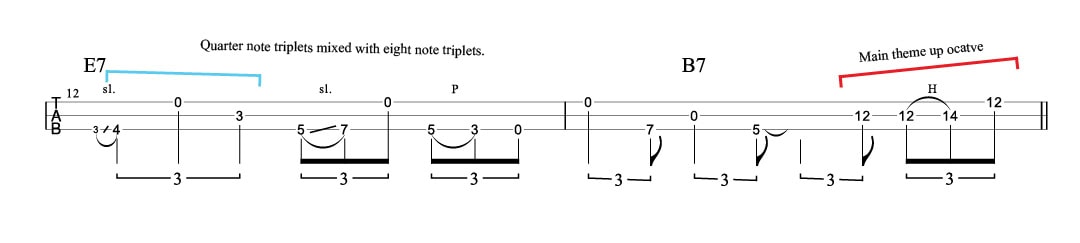
My “Hide Away” lesson shows a lead-up and turnaround at the end of the 12-bar form. Learn the phrase with the bar numbers, not only the fret numbers, so you know exactly why it appears where it does.
Practise one version that returns to the V chord for another chorus and one that resolves firmly to the I chord as an ending. The small change teaches the difference between continuing the form and closing the performance.
Related Terms
Learn More
- Open E Cigar Box Guitar and Blues Tutorial
- Roots Blues Cigar Box Guitar Lesson
- Learn a 12-Bar Jazz Blues on Cigar Box Guitar
- Simple Improvisation Techniques for the 12-Bar Blues
- Open D Blues Riffs and Solos Companion
- Cigar Box Guitar Learning Path
Reviewed by
Brent C. Robitaille,
music educator and founder of
Kalymi Music.