Ukulele Chords Chart
Use this ukulele chords chart to find the essential open chords in standard GCEA tuning. Start with C, Am, F, G, and G7, then use the diagram guide, tuning chart, free PDF, and printable poster when you want the full reference.
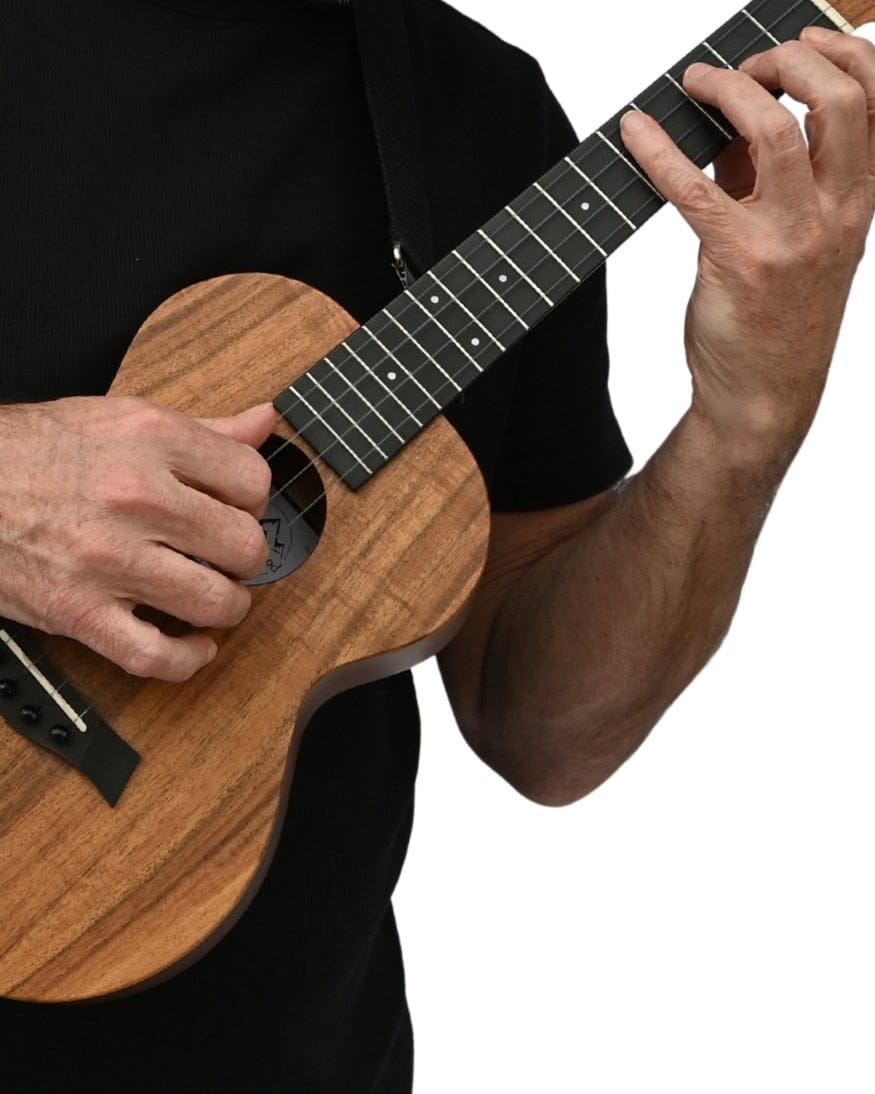
Free ukulele chords chart for standard tuning
The essential open chords below are the first shapes most ukulele players should learn in standard GCEA tuning. They use the same diagram style as the full Kalymi Music poster, so what you practice here matches the printable reference exactly.
Essential open chords (GCEA tuning)
diagram

diagram

diagram

diagram

diagram

diagram

diagram

diagram

diagram

diagram

diagram

diagram

diagram

diagram

These essential open chords are free. Movable and barre examples are shown further down, and the full set is on the printable Ukulele Chord Poster.
Free printable PDF: the essential chords from this page on one sheet you can print and keep by your ukulele.
Download the free PDF ↓Start here: the first ukulele chords to learn
If you're new to ukulele, start with C, Am, F, and G7. These four open chords are the easiest shapes on the instrument, they use standard GCEA tuning, and together they'll carry you through thousands of songs.
Don't try to memorize every chord at once. Learn two or three shapes, practice changing between them slowly, then add the next chord once the changes feel steady.
How to read a ukulele chord chart
Every chord diagram is a snapshot of the neck as if you stood the ukulele up and looked straight at it. Once you can read one, you can read them all.
Ukulele diagram basics

The fingering hand
The finger numbers are the same on every chart: 1 index, 2 middle, 3 ring, 4 pinky, and T for thumb.
The hand is drawn palm up, the way you look down at your own fretting hand, and the arrows show where each finger lands on the neck.
The fretboard grid
- The four vertical lines are the strings, G C E A from left to right.
- The horizontal lines are the frets, counted from the 1st fret down. The thick bar across the top is the nut.
- A dot shows where to press a string down, and the number beneath each string tells you which finger to use.
- An O above a string means play it open. An X means don't play that string.
Barre chords
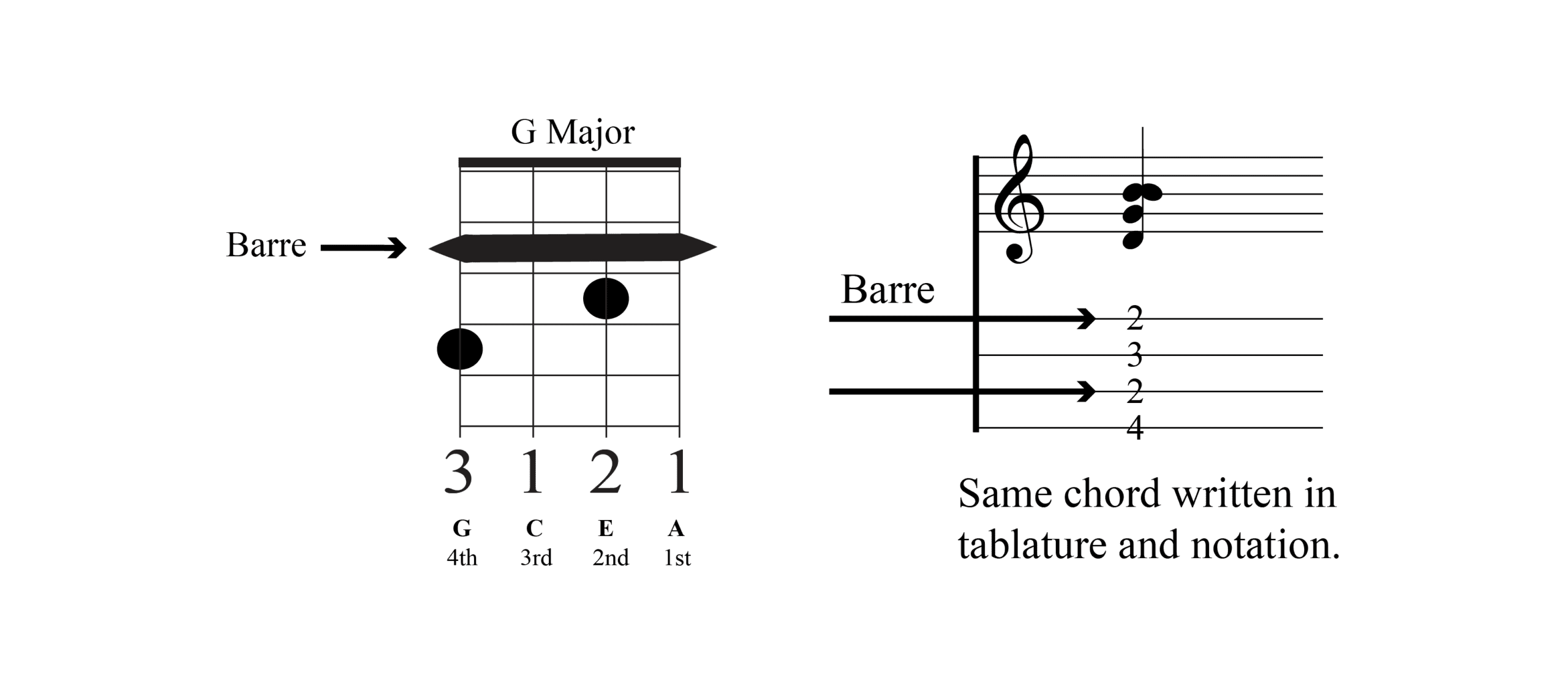
Barre chords ask one finger to cover several strings at once. In the G major example below, lay your 1st finger flat across strings 1 through 4 at the second fret.
Then add your 2nd and 3rd fingers on top to form the shape. Beside the diagram is the same chord written in tablature and standard notation, so you can see how the barre reads either way.
Standard ukulele tuning chart
All the chords on this page assume standard tuning (GCEA). The thing that surprises new players: in the most common tuning the 4th string G is re-entrant, meaning it's pitched higher than the C next to it rather than being your lowest note.
If your chords sound wrong even with the right fingering, check your tuning first.
GCEA tuning from 4th string to 1st string
| String | Note | Played |
|---|---|---|
| 4th | G | High G (re-entrant) |
| 3rd | C | Middle C, lowest note |
| 2nd | E | E |
| 1st | A | A (highest) |
High-G and low-G ukulele tuning
Prefer a deeper sound? Many players use a low-G string instead, which keeps the same GCEA note names but drops the 4th string an octave so it becomes your lowest note.
Every chord shape on this page works in either tuning.
Why these ukulele chord diagrams are arranged this way
Built for quick reference
These diagrams are built as practical playing references. The aim is simple: see the shape, place the right fingers, and come back to the chart whenever you need a reminder.
The picture is there to jog your memory, not to teach theory.
Built for real playing
It's the same visual approach I use in lessons and in the Kalymi Music chord posters: clear shapes and readable finger numbers, so the chords become usable in real songs instead of staying stuck on the page.
What matters most is the practice behind it: clean finger placement, slow changes, and enough repetition for the shapes to become automatic.
Why start with open chords?
The best first chords
The best ukulele chords for beginners are the open chords shown above. They're called open chords because each shape includes at least one open string, and that's what gives the ukulele its bright, ringing sound.
The highest-value group is C, F, G, G7 and the minors Am, Dm, Em.
Why open chords matter
You can play an enormous number of songs with just these few chords. Most ukulele songs never stray far from these basic open shapes, so once they feel comfortable under your fingers, a huge amount of music is already within reach.
C and Am in particular are nearly free, one finger or none.
How to practise them
Don't try to learn them all in a day. Pick two or three, find a song that uses only those, and add the next one when the changes start to feel easy.
Fixing buzzes and muted notes
If a chord buzzes or sounds dead, nine times out of ten it's finger placement or pressure.
The fix I give everyone is the same: play the chord one string at a time. The moment you hit a string that's muted or buzzing, you've found the finger that needs to move.
Reposition it, play it again, and keep going until all four strings ring. Repeat that correct shape enough times and your fingers program it into muscle memory on their own.
How to play movable and barre chords
What a barre chord does
A barre chord uses one finger to press down several strings at once, so a single shape becomes a chord you can slide around the neck.
On ukulele the common hurdles are Bb, B, and Bm. They are worth the effort, because once a movable shape is under your fingers you can use the same idea in many keys.
How to practise barre chords
What actually works: build the barre on its own first and get those strings ringing, then add the other fingers back one at a time.
Keep your wrist out in front of the neck and your barre finger flat against it. Don't squeeze harder than you need to.
Find a song or two that uses Bb, B, or Bm and play those, since nothing builds the shape faster than actually needing it.
Movable and barre chord examples
diagram

diagram

diagram

diagram

diagram

diagram

These are a few examples. The complete set of open, barre, and movable shapes is on the printable Ukulele Chord Poster.
Why do my ukulele chords sound choppy?
The real problem
Here's the part most charts skip. The hard thing isn't knowing the shapes. It's changing between them in time.
If your strumming stops dead every time you switch, you don't need more chords. You need to practice the change on its own.
How to practise chord changes
The way I teach it is to pull the chord changes apart from the strumming completely. Play each chord once, then move to the next one. No rhythm, no strumming pattern, just landing the shape cleanly.
Once that's smooth, play each chord twice, then four times, and keep building.
Timing the release
To land a chord on the beat, you often have to release the one before it slightly early, so your hand has time to get there.
Letting go early feels wrong at first, but that's what keeps the music moving instead of stalling at every change.

Want cleaner changes and stronger strumming? My Ultimate Ukulele Technique & Warm-up Book is built for exactly this: progressive finger workouts, strumming patterns, and chord-change drills in pop, jazz, and blues, plus eight graded solo pieces.
Technique & Warm-up Book →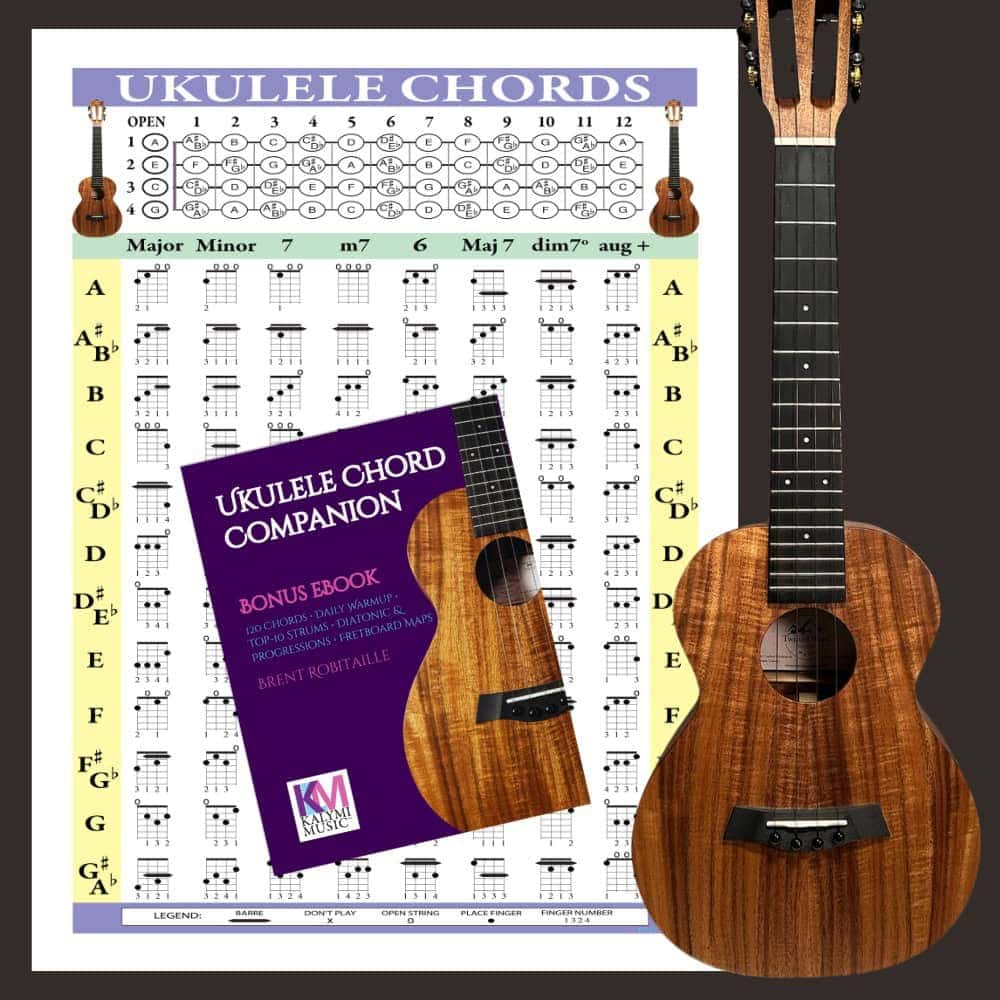
Ready to take the chords off the screen? The Ukulele Chord Poster + eBook is a printable reference with the full set of open, seventh, minor, and movable shapes in the same diagram style you've been practicing here, plus a bonus chord eBook.
Get the Chord Poster →Take your playing further
Once the chords feel comfortable, here's where to go next: the core method and technique books, a value bundle to start, and repertoire you can play with the chords you've just learned.
 Mastering Fingerstyle Ukulele
The complete fingerstyle method: right-hand patterns, control, and real repertoire.
Ultimate Ukulele Technique & Warm-up
Finger workouts, strumming patterns, graded solos, and chord drills for every level.
Mastering Fingerstyle Ukulele
The complete fingerstyle method: right-hand patterns, control, and real repertoire.
Ultimate Ukulele Technique & Warm-up
Finger workouts, strumming patterns, graded solos, and chord drills for every level.
 Starter eBook Bundle
The Fingerstyle and Technique starter eBooks together, the best-value way to begin.
Starter eBook Bundle
The Fingerstyle and Technique starter eBooks together, the best-value way to begin.
 Celtic & World Collection
Celtic and traditional world tunes arranged for ukulele.
Celtic & World Collection
Celtic and traditional world tunes arranged for ukulele.
 Christmas Songbook
Holiday favourites arranged for ukulele, melody, and chords.
Christmas Songbook
Holiday favourites arranged for ukulele, melody, and chords.
 Blank Tablature Workbook
Printable blank ukulele tab and notation sheets, plus a handy reference.
Blank Tablature Workbook
Printable blank ukulele tab and notation sheets, plus a handy reference.
Ukulele chords: common questions
What are the basic ukulele chords for beginners?
The most useful beginner chords are C, F, G, and G7, plus the minors A minor, D minor, and E minor. Learn C, Am, F, and G7 first and you can play a huge range of pop, folk, and island songs.
What order should I learn ukulele chords in?
Start with C and A minor, which need one finger or none, then F and G7, then G. Add the sevenths like C7 and A7 once the open shapes feel comfortable, and save barre chords like Bb, B, and Bm for later.
What are the easiest ukulele chords to play?
C major is the easiest chord on the instrument: a single finger on the bottom string. A minor is next, and F and G7 use just two or three fingers. That's why those four are the classic starting set.
How do I read a ukulele chord diagram?
The four vertical lines are the strings, G C E A from left to right. Horizontal lines are frets, and the thick top bar is the nut. Dots show where to press, numbers tell you which finger to use, O means play the string open, and X means don't play it.
What is standard ukulele tuning?
Standard ukulele tuning is G C E A. In the most common re-entrant setup, the 4th string G is tuned high, so the 3rd string C is your lowest note. A low-G string is a popular alternative that keeps the same chord shapes.
Why do my ukulele chords sound buzzy or muted?
Usually it's finger placement or pressure. Press just behind the fret rather than on top of it, arch your fingers so they don't touch neighbouring strings, and make sure your tuning is correct before blaming the chord.
What's the difference between high-G and low-G tuning?
High-G, or re-entrant tuning, gives the bright classic ukulele sound. Low-G drops the 4th string an octave for a fuller range and more bass, which suits fingerstyle and solo playing. The chord shapes on this page work in both.
Keep going