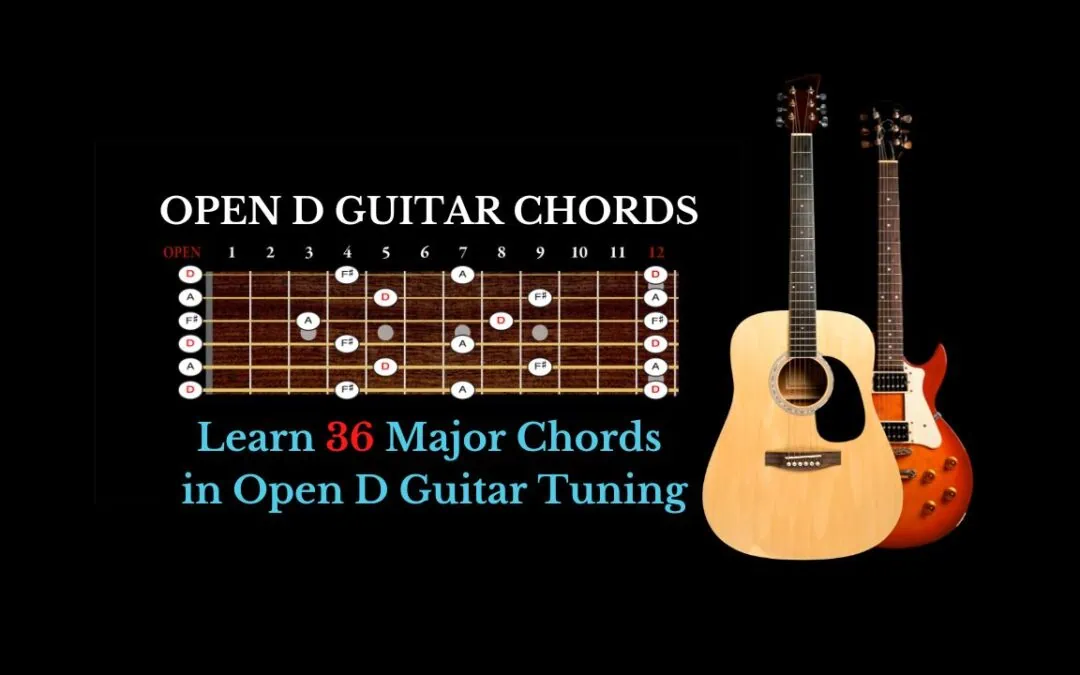
Open D Guitar Chords: D A D F# A D
Open D guitar tuning changes the guitar from standard tuning to D A D F# A D from low to high. When you strum the open strings, you hear a D major chord. This tuning is useful for blues, slide guitar, fingerstyle, folk guitar, Celtic guitar, and full-sounding movable chord shapes.
This lesson focuses on major chords in Open D tuning, especially the primary chords in the key of D: D, G, and A. You’ll learn how to tune to Open D, play common major chord shapes, move those shapes around the neck, and use them in chord progressions.
Start here:
- Need the basic chord shapes? Start with the D, G, and A major chords below.
- Want Open D blues riffs and solos? See 101 Blues Riffs and Solos in Open D Guitar Tuning.
- Comparing Open D, Open G, DADGAD, and Drop D? Follow the Open Tunings Guitar Learning Path.
Open Tunings Guitar Learning Path
Open D is one part of a larger open tuning system. For a practical path through Open D, Open G, DADGAD, and Drop D, visit the Open Tunings Guitar Learning Path.
How to Tune to Open D Guitar Tuning with a Tuner
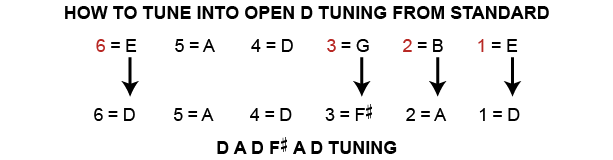
Open D tuning is D A D F# A D from low to high. From standard tuning, only three strings change: the 6th, 3rd, and 1st strings. The 5th, 4th, and 2nd strings stay the same.
Using a guitar tuner, tune from standard guitar tuning E A D G B E to Open D:
- Lower the 6th string from E down to D.
- Leave the 5th string tuned to A.
- Leave the 4th string tuned to D.
- Lower the 3rd string from G down to F#.
- Leave the 2nd string tuned to B.
- Lower the 1st string from E down to D.
When all six strings are tuned to D A D F# A D, strum the open strings and listen for a clear D major chord.
How to Tune Open D by Ear
A tuner is useful at the start, but it is worth learning the sound of Open D by ear. The open 4th string D is your main reference note.
- Play the open 4th string D, then lower the 6th string from E down to D. Match it so it sounds one octave lower than the 4th string.
- Play the open 4th string D again, then lower the 1st string from E down to D. Match it so it sounds one octave higher than the 4th string.
- You should now have three D strings: the 6th, 4th, and 1st strings. Play them together and adjust until the three D notes sound settled and in tune.
- Finally, lower the 3rd string from G down a half step to F#. Check it with a tuner at first, then listen to how it completes the open D major chord.
The goal is not just to reach the correct notes, but to recognize the sound of the tuning. Over time, the open D chord should become familiar enough that you can hear when one string is slightly off.
Primary Chords in the Key of D
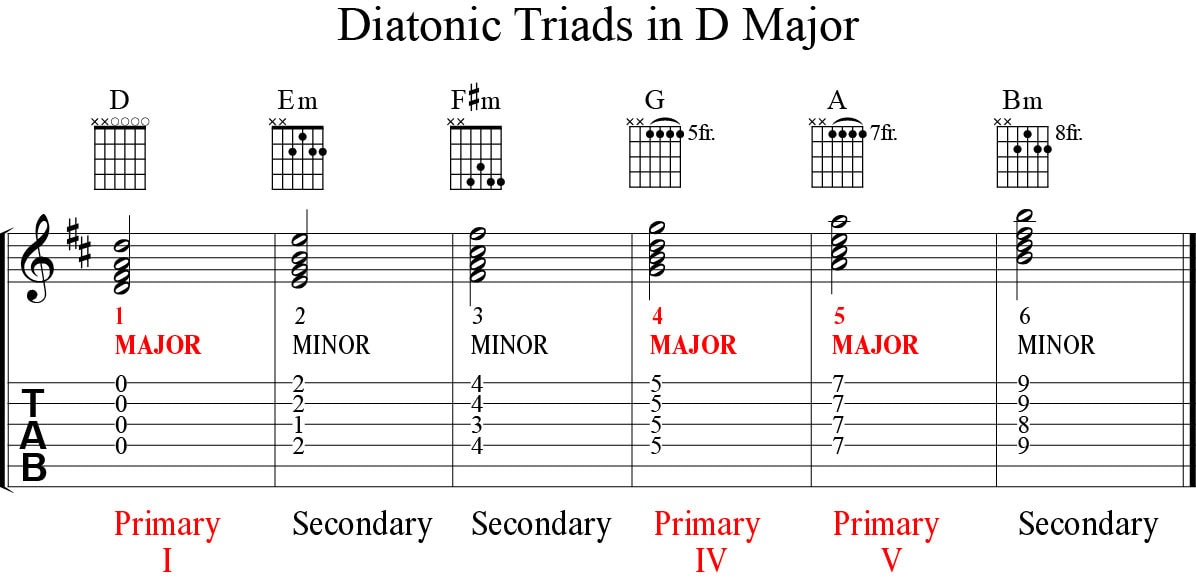
The primary chords in D major are D, G, and A. These chords are built from the 1st, 4th, and 5th degrees of the D major scale. In Roman numerals, they are written as I, IV, and V.
These three chords are the foundation of many songs in a major key, especially folk, blues, country, and roots music. In Open D tuning, the open strings already form a D major chord, so the next step is learning where the G and A major chords fall on the neck.
In this lesson, we’ll look at several ways to play the main major chords in Open D tuning: D major, G major, and A major.
Want to apply Open D chords to blues riffs and solos? See 101 Blues Riffs and Solos in Open D Guitar Tuning.
Now that you know the primary chords in D major let’s learn four ways to play each chord. First, we will learn four D major chords up to the 12th fret.
Want to learn some blues riffs and solos in Open D? Check out my book “101 Blues Riffs in Open D”
D Major Chords in Open D Tuning
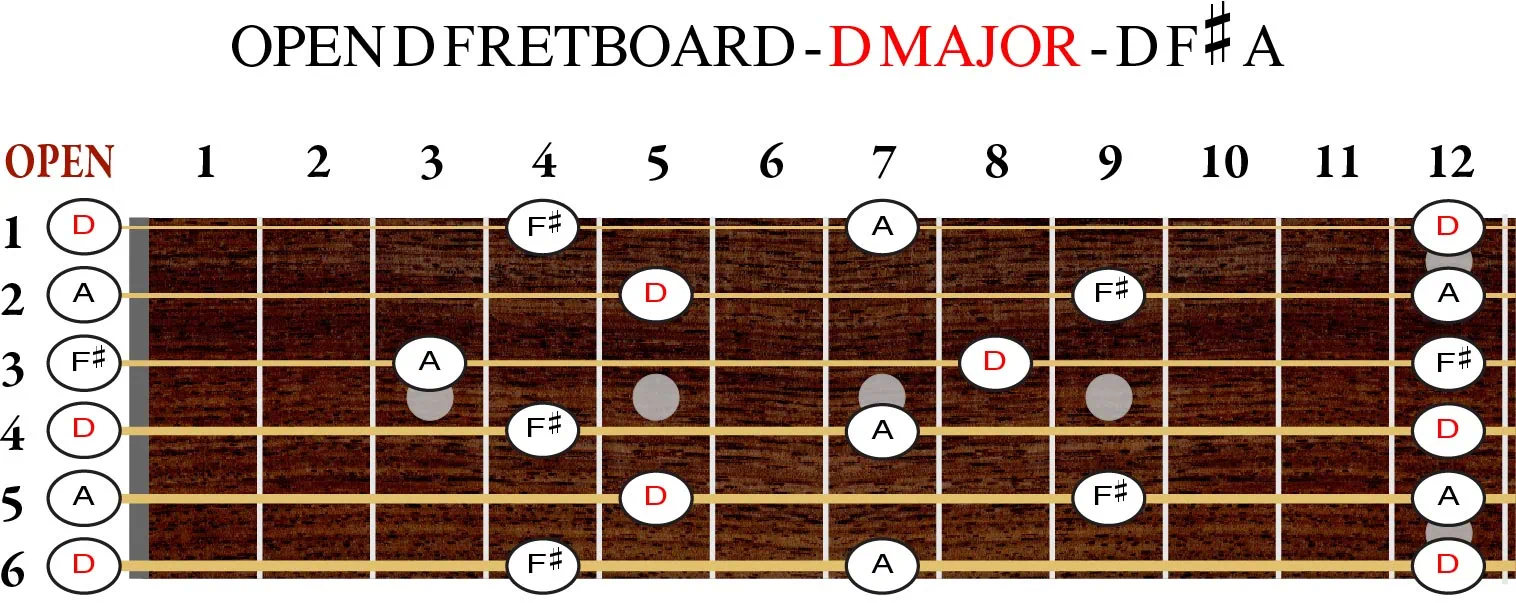
The easiest Open D chord is the open-string D major chord. Strum the open strings, and you already have the notes of the chord: D, F#, and A.
From there, you can build several D major shapes across the neck. Some shapes use four strings, while others can be expanded or reduced depending on the sound you want. As long as the chord contains D, F#, and A, it functions as a D major chord.
Start with the most comfortable shapes first, then move them into chord progressions so they become part of your playing instead of isolated diagrams.
Next chord study: After you learn the major shapes, continue with the Open D Minor Chords Lesson.
Chord Inversions – Theory
The best way to think of chord inversions is to see the notes of the chord as a geometrical shape. The root note is a square, the 3rd is a triangle, and the 5th of the chord is a circle. The notes of the chord (or shapes) can be rearranged in three ways:
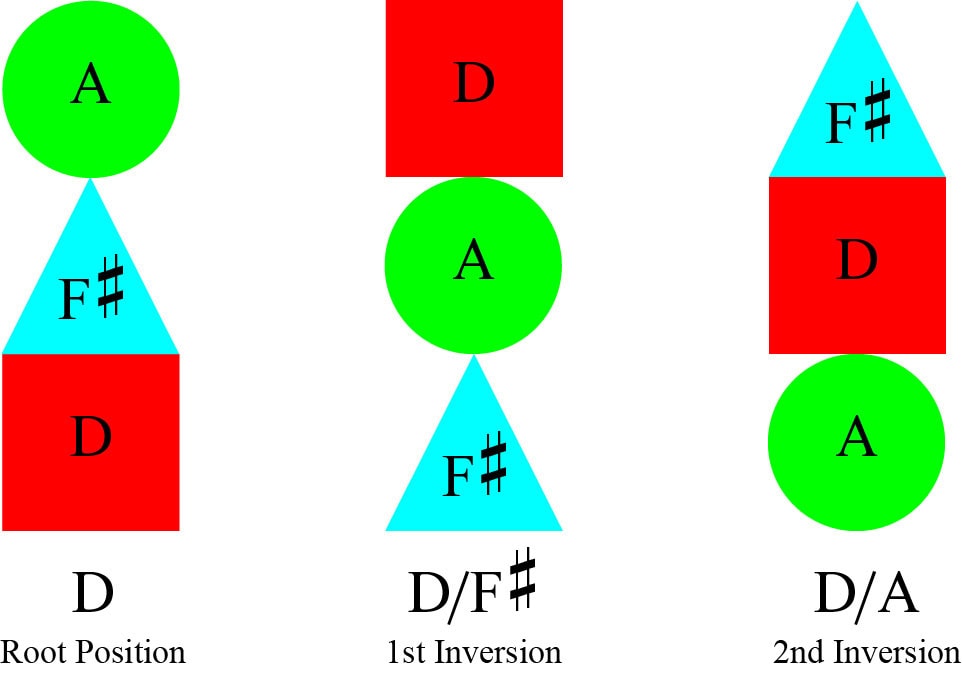
And as long as we play the 3 notes together, we are playing the D major chord. If D is the lowest-sounding note, we play a D major in root position. When the F# is the lowest note, we play a D major in first inversion, often written with a slash: D/F#. If the A is the lowest note, then we are playing a D major chord in 2nd inversion. This chord is written like this: D/A.
All three are D chords but have different harmonic functions and sound. Generally, the root position is preferred, while the 1st and 2nd inversions are used as transitional chords (D/F#) or substitute dominant chords (D/A).
It’s a good idea to memorize all the major chord shapes in the video as they can be transposed to different keys, greatly expanding your chord repertoire.
Let’s move on to the fourth chord of D (IV): G major.
G Major Chords in Open D Tuning
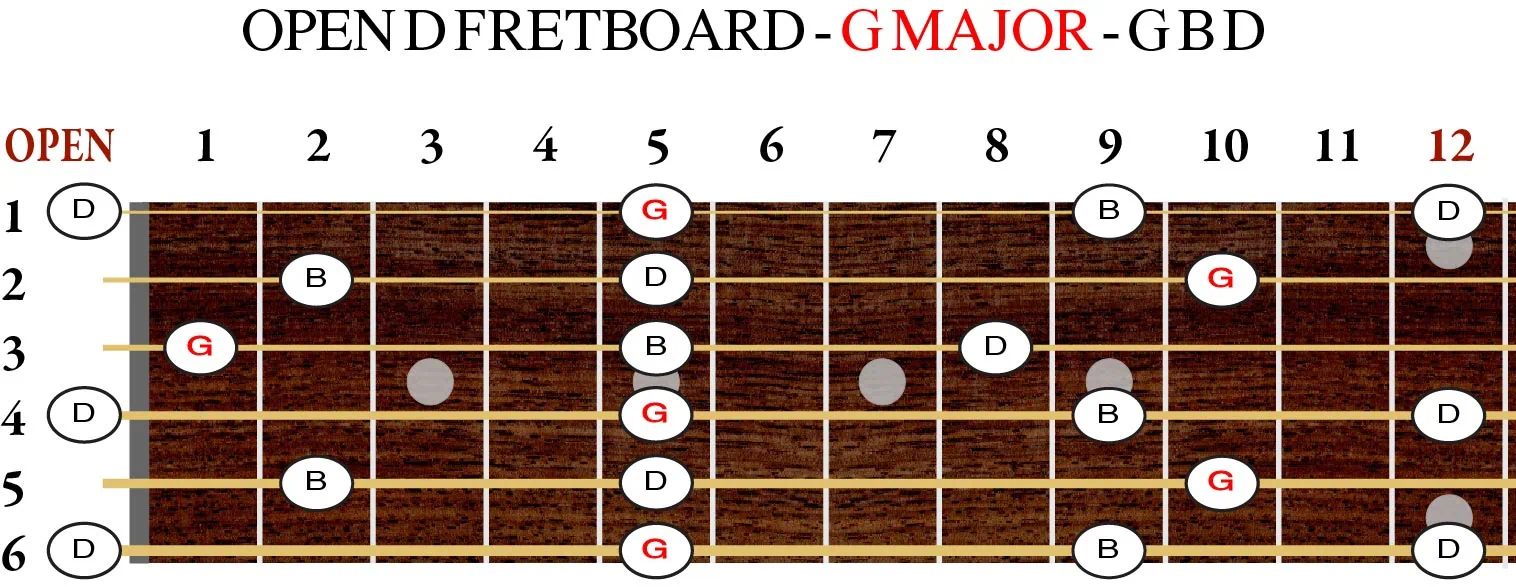
You will start recognizing the major chord shapes reoccurring as you learn the G chords in open D tuning. All these chords are moveable, meaning you just take the chord and shift it down the neck to play different chords. This is what the notes of the G major chord look like in Open D tuning:
Now watch the video to learn 12 G major chords:
Finally, we can learn the A major chords in Open D tuning.
The A Major Chord in Open D
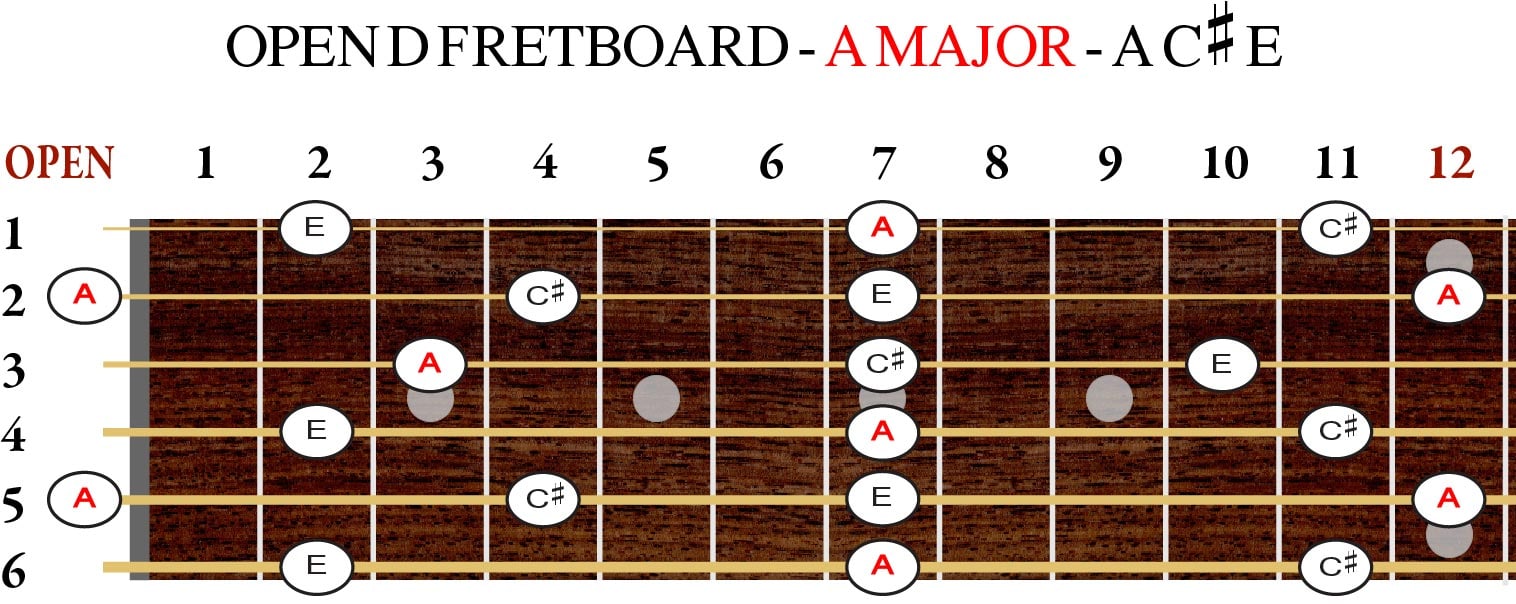
Hopefully, by now, you know the shapes you learned on the D and G chords. Our last chord is the A major chord (A, C#, E). Here are the notes of the A major chord on the fretboard.
Now watch the video to learn 12 A major chords:
So, now you can try to memorize the reoccurring chord shapes and apply them to your songs. How about we put our chords to use and learn a few chord progressions in D major?
Popular Songs with Open D Primary Chords
The chord progressions below are taken from popular songs you have likely heard before. Playing in Open D gives a new sound to songs originally played in standard guitar tuning. They will sound different because they have different voicings (arrangement of notes), but that could be good.
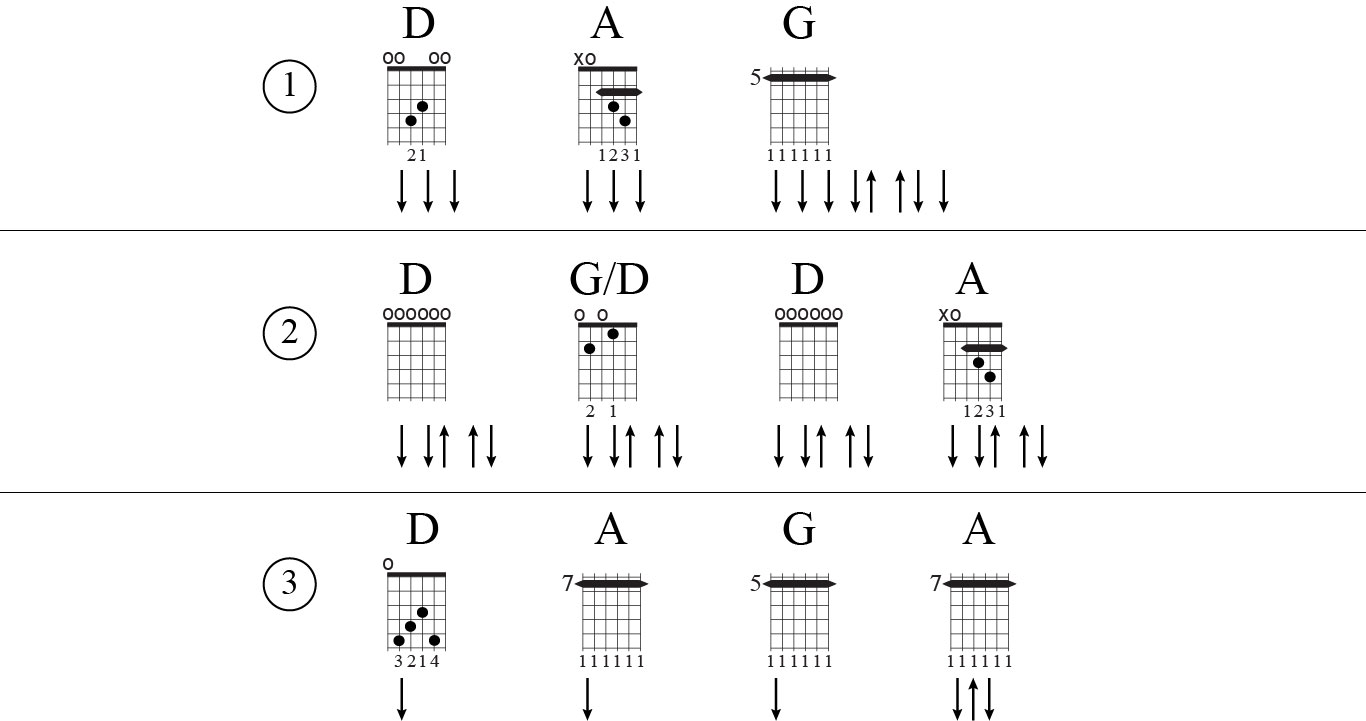
Maybe this will inspire you to convert some of your standard tuning guitar songs into your repertoire with Open D. Not everything is in D major, so you must transpose the chords to the key of your choice. Take the moveable shapes and transpose them to the appropriate key.
Related Open Tuning Lessons
If you want to continue exploring open tunings, these related lessons and resources connect well with this Open D chord lesson:
CHECK OUT MY NEW VIDEO COURSE:
OPEN G GUITAR TUNING
WITH 101 RIFFS BLUES.
NOW AVAILABLE AT UDEMY.COM
Transposing Open D Chords
That’s it for the primary chords in D major. The next step is transposing these chord shapes to the other major keys. The chord shapes from this lesson are likely the most played major chords in Open D tuning, but there’s no reason not to learn all the keys to master Open D guitar tuning fully.
Play the major chords using the circle of fifths. Experiment with different string sets but try to keep your hand within a five to six-fret span:
F C G D A E B F# C# G# Eb Bb
Of course, the major chords are essential to learning, but minor chords are no less important. That will have to wait until our next Open D chord lesson: learning the secondary chords in D major.
Check back again for the next lesson. Subscribe for new lessons, books and sheet music arrangements to continue your Open D journey.
________________
When Open D Guitar Chords Are the Right Choice
When is Open D better than Open G?
Open D is often the better choice when you want a full, deep, resonant sound with strong bass support. It works especially well for slide guitar, solo playing, and slower blues or folk styles. Open G tends to feel brighter and punchier, while Open D feels wider and more sustained.
Is Open D better for slide or fretted playing?
Open D works extremely well for both. Slide players benefit from the open major chord and wide string spacing, while fretted players can build strong chord shapes and partial voicings without complex fingerings. Many players use Open D as a hybrid tuning for slide and fretted passages.
What should I practice first in Open D?
Start with the open D chord, then learn the 5th-fret (G) and 7th-fret (A) barre shapes. From there, add one movable minor shape and one partial chord. This order lets you play real progressions quickly instead of memorizing dozens of shapes.
FAQs About Open D Guitar Chords
What is Open D tuning on guitar?
Open D tuning is D A D F# A D from low to high. When you strum the open strings, you hear a D major chord. This makes the tuning useful for slide guitar, blues, folk, fingerstyle, and open-string chord voicings.
What strings change from standard tuning to Open D?
From standard tuning, lower the 6th string from E to D, lower the 3rd string from G to F#, and lower the 1st string from E to D. The 5th, 4th, and 2nd strings stay the same.
What are the main major chords in Open D?
The main major chords in the key of D are D, G, and A. The open strings give you D major, the 5th fret gives you G major, and the 7th fret gives you A major. For more shapes, see the Open D Chord Poster.
Is this lesson good for beginners?
Yes. Start with the open D chord, then learn the 5th-fret G barre shape and the 7th-fret A barre shape. Those three chords are enough to start playing simple progressions in Open D tuning.
What should I practice after the basic Open D major chords?
After D, G, and A, practice simple progressions, then add minor chords, dominant seventh chords, and blues phrases. The goal is to use the shapes in real music instead of only memorizing chord diagrams.
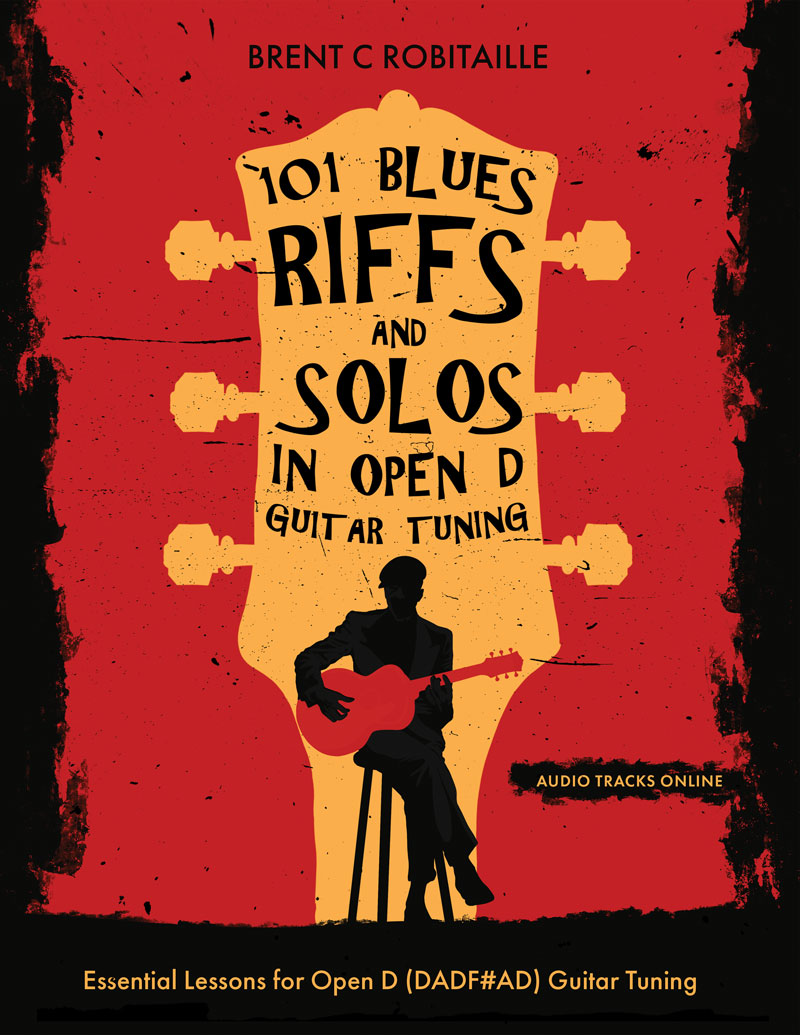
101 Blues Riffs and Solos in Open D Guitar Tuning
Take your Open D guitar playing to the next level with “101 Blues Riffs & Solos in Open D Guitar Tuning.” The most complete instructional book ever written exclusively in DADF#AD tuning. Using a combination of slide, fingerstyle and pick playing, you will cover all the bases needed to develop a solid technique in open D guitar. Everything you need to master the blues with essential lessons in DADF#AD guitar tuning!
Includes:
- Master the Blues in Open D Guitar Tuning
- Slide, Fingerstyle and Picking Riff and Solos
- Traditional, Delta, Rock, Funk and Jazz Blues
- Extensive Scale, Chord, and Arpeggio Charts
- A Complete Course for Open D (DADF#AD)
- Audio Tracks Bellow
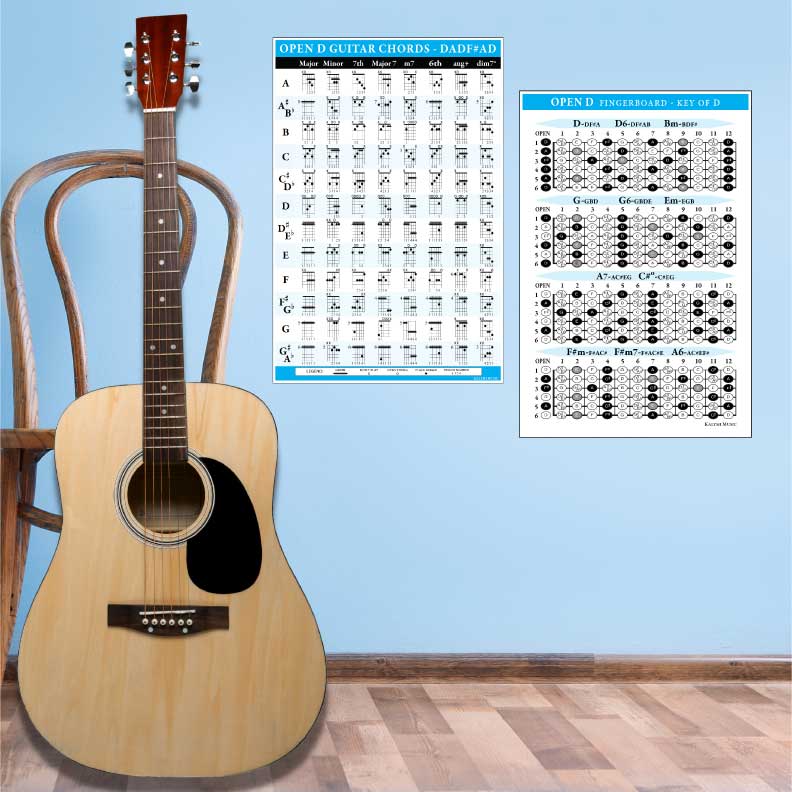
OPEN D (DADF#AD) Guitar Chord and Fingerboard Posters
Updated Version Available
This Open D guitar chord poster was originally offered in an earlier printed poster format. That version is no longer produced.
The reference has been updated as a single Open D studio poster, printed locally and including a printable & tablet-ready PDF.
Available in three poster sizes to fit your practice space or studio wall.
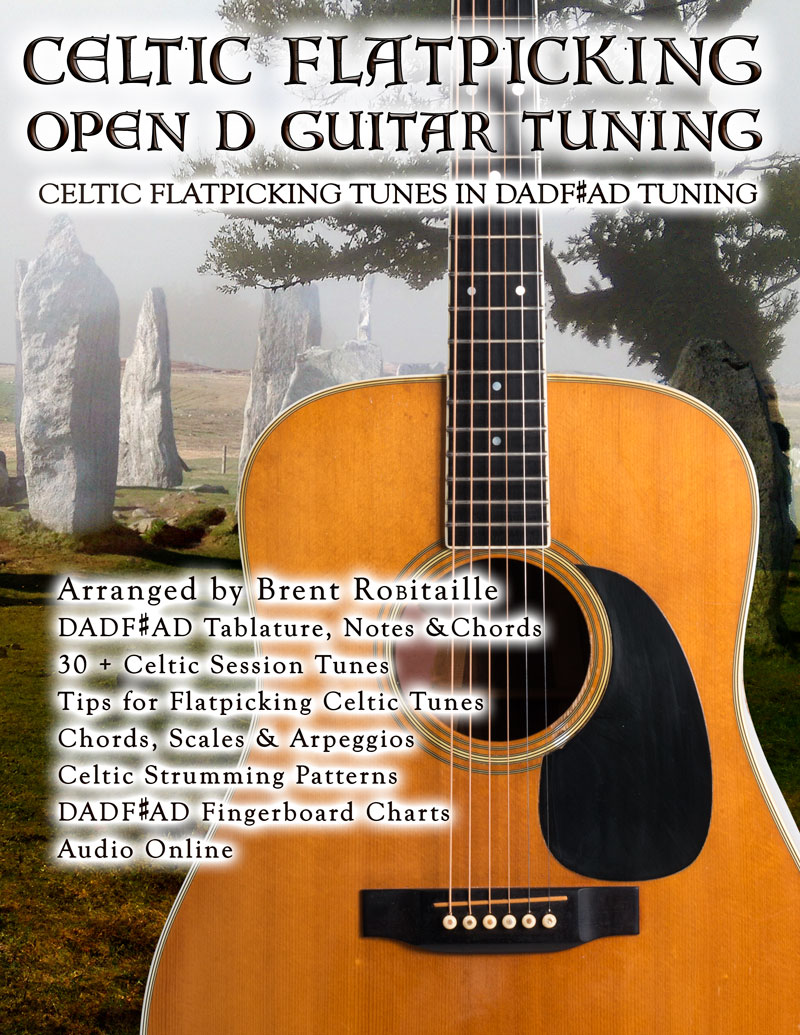
Celtic Flatpicking Open D Guitar Tuning
Celtic Guitar Flatpicking in Open D Guitar. Tuning your guitar to DADF#AD or “Open D” tuning compliments Celtic guitar music perfectly.
- 30+ Celtic session tunes and songs. Jigs, reels, songs, hornpipes, waltzes.
- Tips for Flatpicking and Ornamentation.
- DADF#AD chords and arpeggios.
- Celtic strumming patterns.
- Campanella major, minor and modal scales.
- DADF#AD fingerboard chart.
- A selection of audio and interactive tracks below
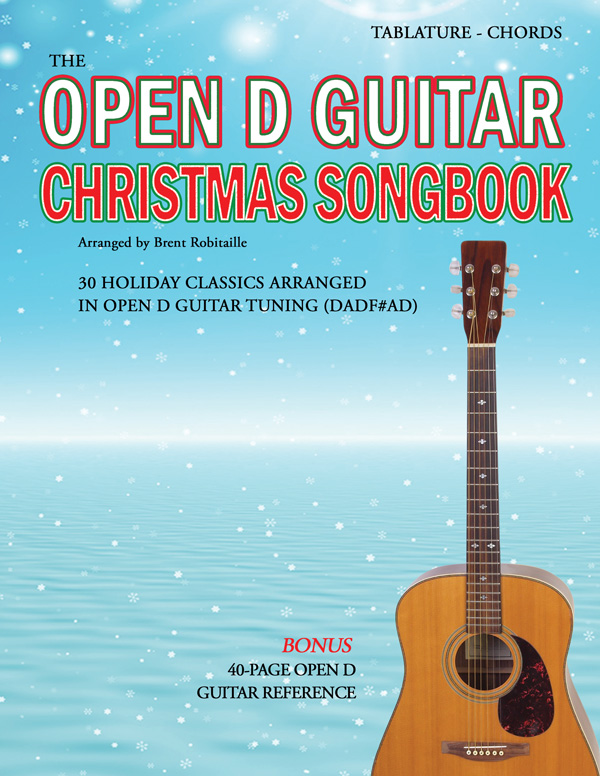
The Open D Guitar Christmas Songbook
The Open D (DADF#AD) Guitar Christmas Songbook has thirty of your holiday favourites with Tablature and notation. Also includes:
- 30 fingerstyle arrangements for players looking for a fuller-sounding chord melody (chords and melody together).
- A 30+ page reference section includes a chord library of the most common Open D guitar chords,
- Strumming and fingerpicking patterns,
- Chord and arpeggio fingerboard diagrams in every key,
- And a collection of Open D scales and scale patterns to warm up your fingers.
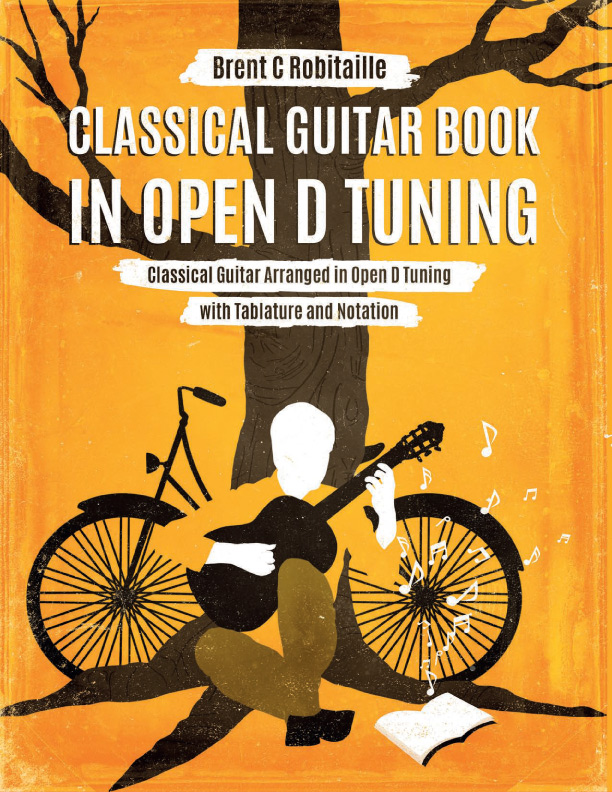
Classical Guitar Book in Open D Tuning
45 New Arrangments for Classical Guitar Players in Open D Tuning
• Tablature, Notation, Fingerings, and Performance Markings
• 24 of Giuliani’s right-hand technical exercises arranged for Open D
• Scales, arpeggios and chords to master the fingerboard
Looking for some good RHD picking patterns
Do you mean right-hand patterns in open D?
I want to key on 3 tunings on 3 guitars, open d,open e,& e standard.
Just got my first resonator guitar and am taking a short class in slide, rhythm and blues. Looking forward to venturing through your lessons afterwards. Thank you. Dan R.
Really clean web site, thanks for this post.