

Guitar Dictionary Category
Classical & Flamenco Guitar
What Is Tirando on Guitar?
Tirando is the Spanish term for the classical-guitar free stroke. After a finger plucks a string, it follows through toward the palm without coming to rest on the adjacent string.
Tirando is the most frequently used right-hand stroke in classical guitar because it allows neighbouring strings to remain available for arpeggios, chords and independent voices.
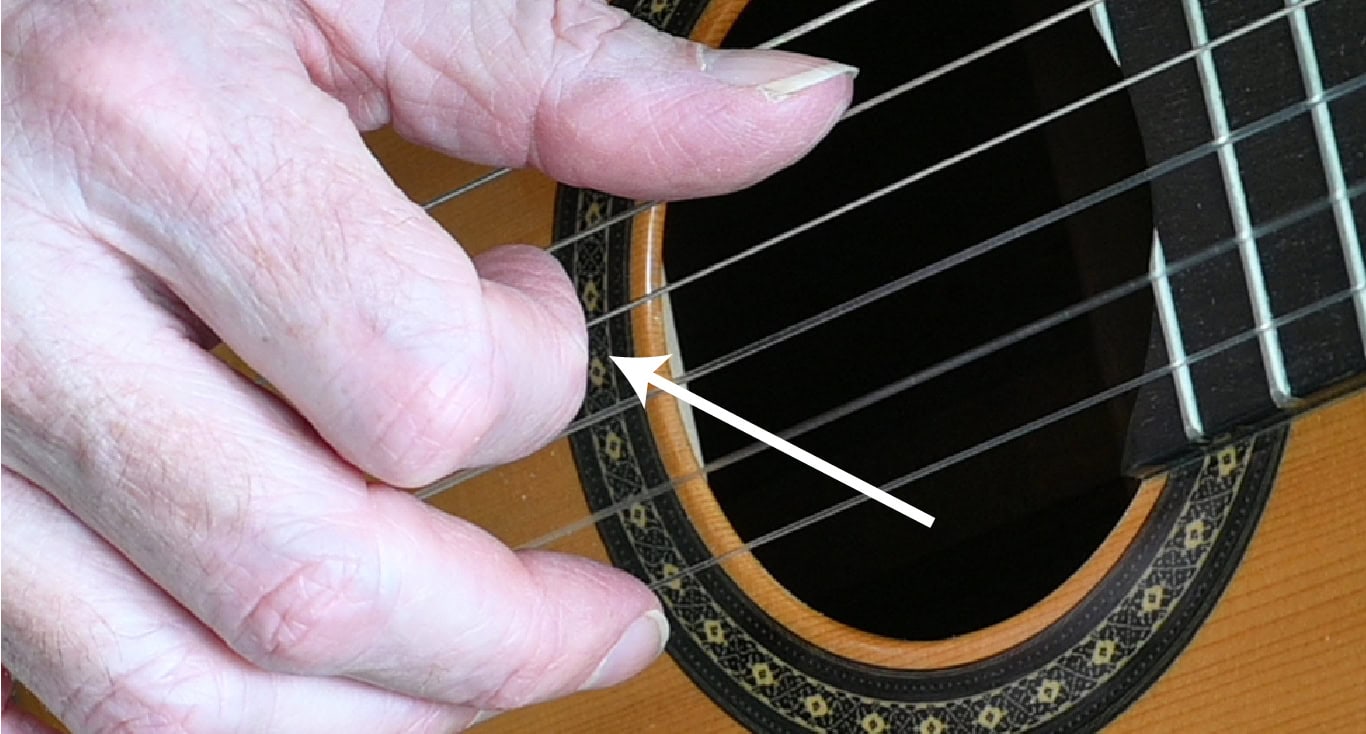
How Tirando Differs from Apoyando
In apoyando, or rest stroke, the finger finishes against the adjacent lower-pitched string. Tirando clears that string and continues through the air.
Apoyando often produces a fuller, more projected attack and is useful for melody and accents. Tirando is more adaptable when several strings must ring together or when the fingers move through an arpeggio.
How to Play a Free Stroke
- Keep the wrist comfortably elevated and the hand stable.
- Approach the string with the finger at a natural angle.
- Contact the string with flesh and nail according to your normal tone production.
- Move from the large knuckle joint.
- Pass through the string and continue toward the centre of the palm.
The finger should not hook sharply upward away from the guitar. The motion moves through the string, not across its surface.
Tirando with the Thumb
The thumb can also use a free stroke. It moves away from the fingers and clears the next string instead of stopping against it. Thumb tirando is essential when a bass note must sound without muting a neighbouring sustained string.
Alternation Exercise
Play one open treble string with i–m alternation. Listen for equal tone and volume. Repeat with m–a and i–a, then move the same alternation across the first three strings.
Round 1: four notes with i–m.
Round 2: accent only the first note.
Round 3: crescendo across four notes without changing tempo.
When Tirando Is the Better Choice
Use tirando when the adjacent string must continue ringing, when playing arpeggios and chords, or when a lighter and more flexible attack suits the phrase. The decision should come from the texture and tone rather than from using one stroke automatically.
Why Tirando Matters
Tirando is the foundation of most classical and fingerstyle right-hand work. A controlled free stroke supports tone colour, dynamics, arpeggios, tremolo and independent melody-and-bass textures.
Kalymi Tip
In my classical-guitar lesson, I recommend keeping the hand relatively still and moving the finger from the large knuckle joint. Allow the smaller joints to remain relaxed and controlled rather than locking them.
Practise one note tirando and apoyando at the same volume. The strokes should sound intentionally different, not merely loud and soft versions of the same uncontrolled movement.
Related Terms
Learn More
- How to Play Classical Guitar: Lesson One
- Mastering Fingerstyle Ukulele Companion
- Guitar Fingerpicking Poster
- Guitar Learning Path
- Free Stroke Technique
- Kalymi Music Library
Reviewed by
Brent C. Robitaille,
music educator and founder of
Kalymi Music.