

Guitar Dictionary Category
Classical & Flamenco Guitar
What Is Apoyando on Guitar?
Apoyando is the Spanish term for the classical and flamenco guitar rest stroke. After the finger plays one string, it follows through and comes to rest against the adjacent lower-pitched string.
For example, the index finger can play the first string and finish against the second string without sounding it. The resting contact gives the stroke its English name.
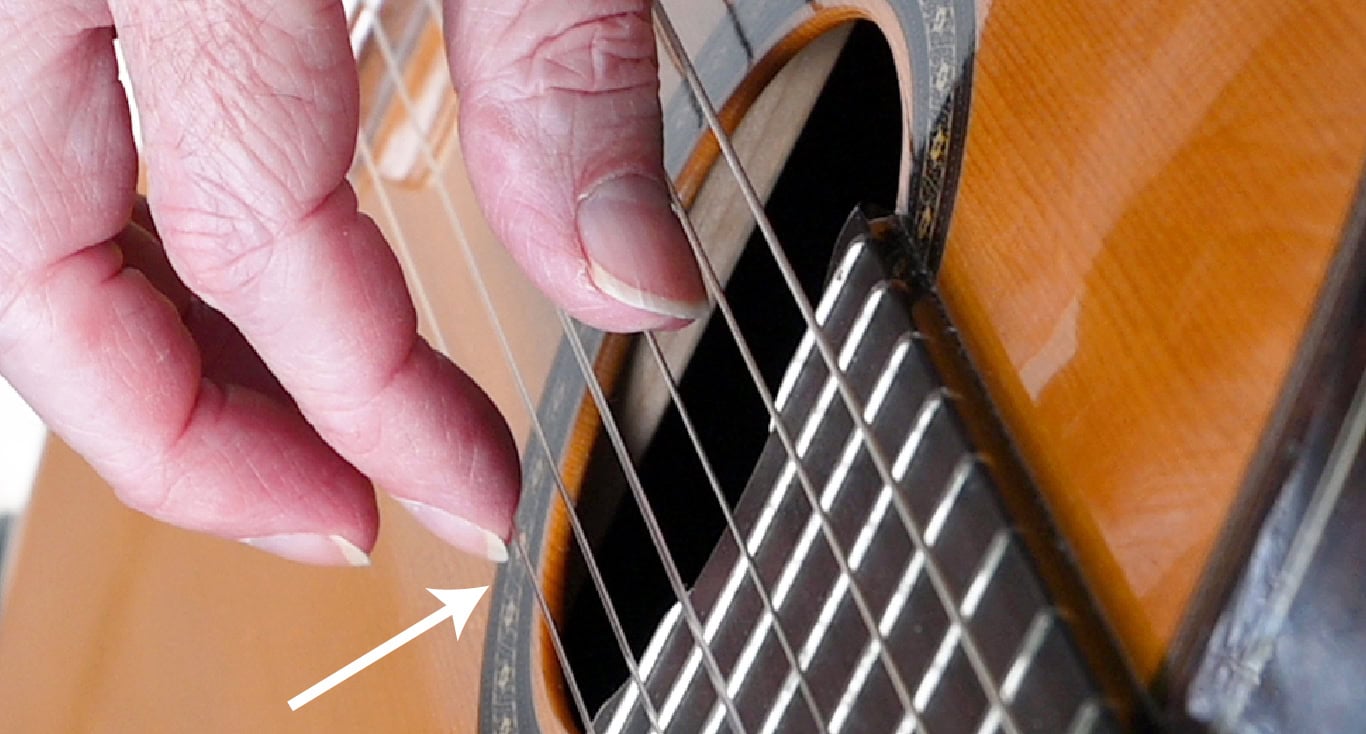
Apoyando vs Tirando
In tirando, or free stroke, the finger clears the adjacent string and continues toward the palm. In apoyando, the finger follows through into the next string.
Apoyando often creates a fuller, more focused attack and is useful for melody notes, accents and scale passages. Tirando is more flexible for arpeggios and textures in which several neighbouring strings must continue ringing.
How to Play Apoyando
- Keep the hand stable and the wrist comfortably elevated.
- Contact the string with flesh and nail according to your normal tone production.
- Move mainly from the large knuckle joint.
- Pass through the string rather than pulling upward away from the guitar.
- Allow the finger to finish against the adjacent string.
The resting string should not sound. It acts as the controlled end point of the motion.
Alternating Fingers
Practise apoyando with i–m alternation on one string. Begin slowly enough that both fingers produce similar tone and volume. Then play a scale across the strings and prepare each finger before its attack.
Using Apoyando for Melody
A melody can be brought forward by playing it apoyando while accompanying notes use tirando. The two strokes create a natural tone and dynamic contrast without requiring the melody to be forced.
Do not use rest stroke where the landing finger would stop a note that must continue ringing. The musical texture determines whether apoyando is appropriate.
Thumb Rest Stroke
The thumb can also use a rest stroke, moving through a bass string and finishing against the adjacent higher-pitched string. Its hand angle and direction differ from the finger stroke, so practise it separately.
Why Apoyando Matters
Apoyando gives classical and flamenco guitarists a controlled way to shape melody, accents and scale tone. Its value comes from the sound and musical emphasis it creates, not merely from touching the next string.
Kalymi Tip
My classical guitar lesson describes rest stroke as a rounder, fuller sound that is useful for accents and bringing out the melody. Listen for that tonal difference rather than treating the landing string as the whole technique.
Practise one scale twice: first entirely tirando, then entirely apoyando. Record both versions and compare tone, volume, sustain and how the hand changes position.
Use apoyando selectively. If the adjacent string must continue ringing, choose tirando or another fingering so the melody can be emphasized without cutting off the accompaniment.
Related Terms
Learn More
- How to Play Classical Guitar: Lesson One
- How to Play Classical Guitar: Lesson Two
- Classical Guitar Book in Open D Tuning
- Guitar Fingerpicking Poster
- Rest Stroke Technique
- Guitar Learning Path
Reviewed by
Brent C. Robitaille,
music educator and founder of
Kalymi Music.